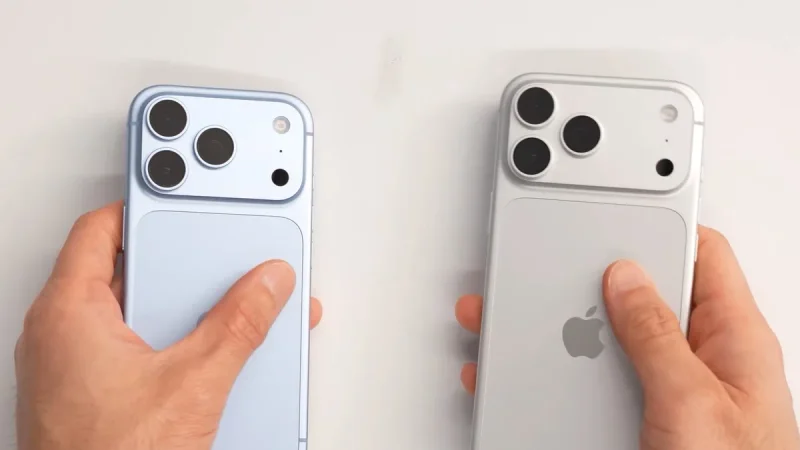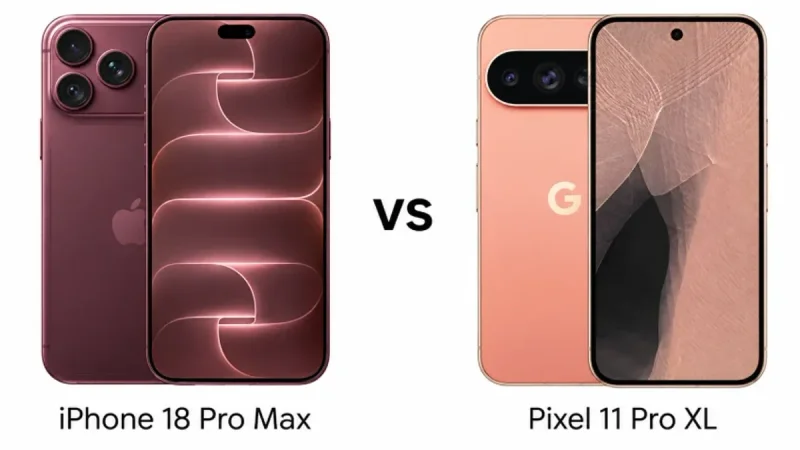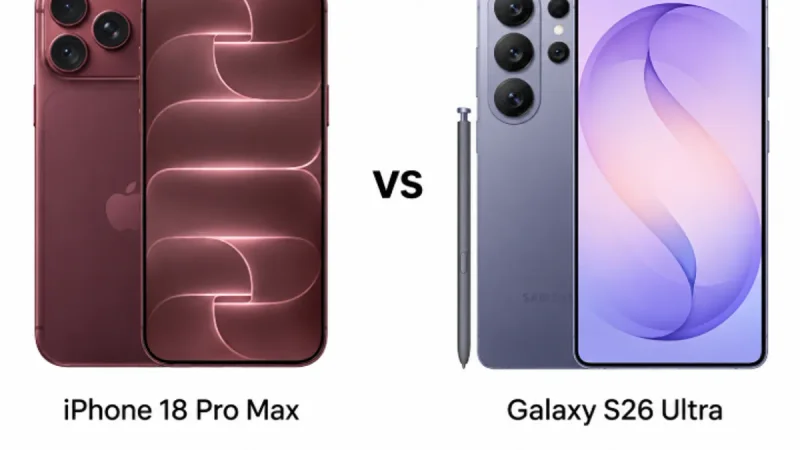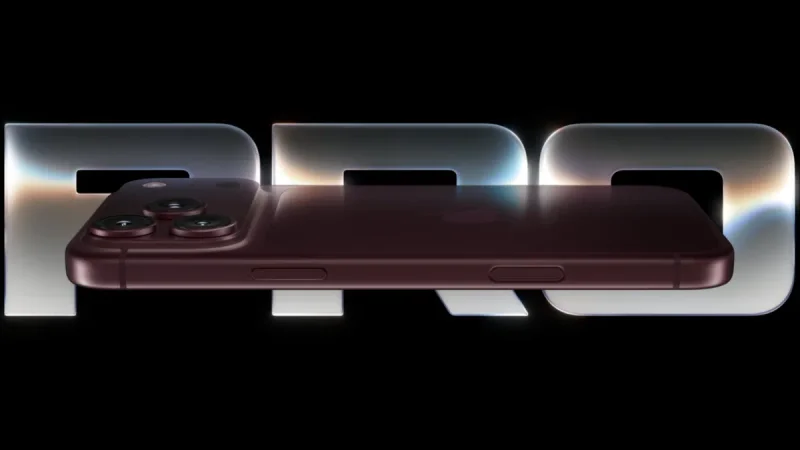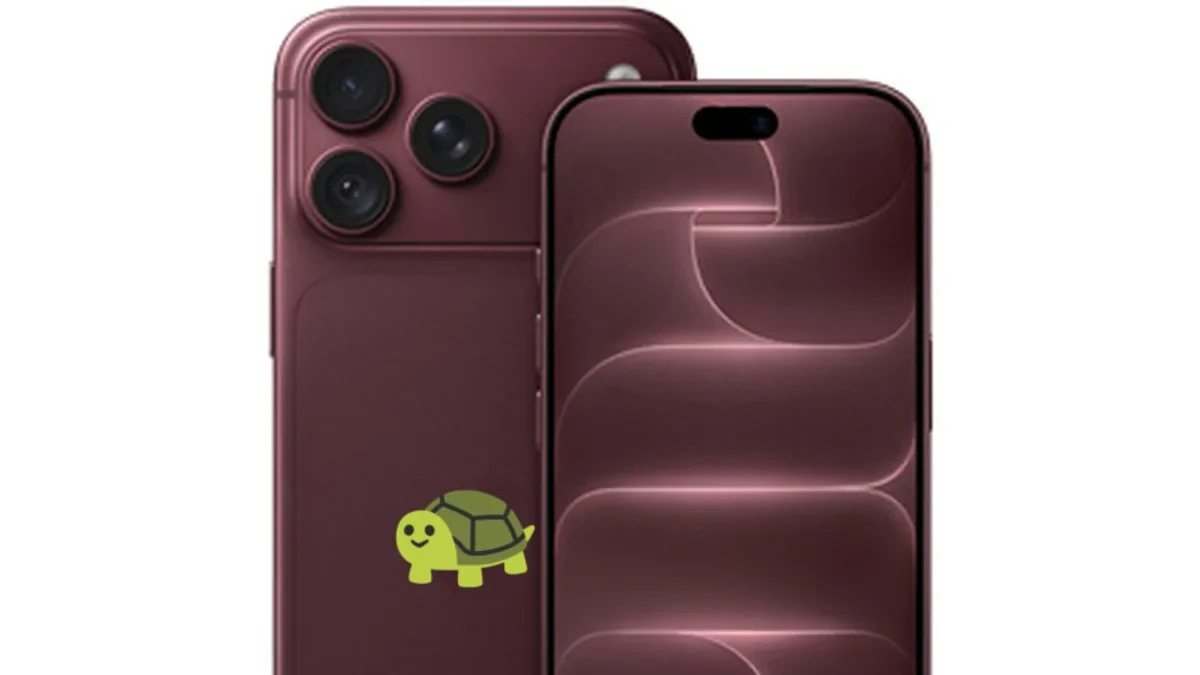
Apple's top-tier iPhone 18 Pro Max is designed to represent the pinnacle of mobile hardware, but its highest-capacity 1TB storage variant may harbor a frustrating performance bottleneck. Recent real-world storage benchmarks reveal that the expensive 1TB model utilizes slower quad-level cell (QLC) flash storage, which can experience dramatic speed drops under heavy, sustained workloads. While global pricing for the 1TB configuration has not been officially detailed in these tests, it typically carries one of the industry's steepest premiums, making these performance compromises particularly tough to swallow for power users.
The performance discrepancy becomes glaringly obvious when compared directly to the triple-level cell (TLC) storage used in lower-capacity models like the 512GB iPhone 18 Pro. While casual users browsing social media or taking quick photos will notice no difference, those who purchase the 1TB model specifically for massive file transfers, system restores, or recording high-bitrate ProRes video may find their premium device grinding to a crawl.
The Technical Compromise: TLC versus QLC Flash
To understand why this slowdown occurs, it helps to look at the underlying flash memory architecture. Most modern flagship smartphones rely on triple-level cell (TLC) flash storage, which stores three bits of data per memory cell. Following the widespread adoption of 3D NAND technology, TLC has become the industry standard, offering an excellent balance of raw speed, capacity, and long-term durability.
In contrast, the 1TB iPhone 18 Pro Max utilizes quad-level cell (QLC) storage, which packs four bits of data into each memory cell. While this allows Apple to fit higher storage capacities onto a single physical chip, QLC cells must distinguish between more voltage states. This inherent complexity makes QLC storage slower and less durable than its TLC counterparts.
Testing conducted by the Bilibili channel HOMOLAB highlights this performance gap. When comparing the QLC-based 1TB iPhone 18 Pro Max against a 512GB TLC-based iPhone 18 Pro, the two devices performed similarly in weighted 4K read tests, scoring 46,045 and 51,282 respectively. However, the gap widened significantly in mixed read and write workloads. Under low queue depths, the TLC-equipped model led by roughly 38 percent (11,285 versus 8,168), though this gap narrowed to about 12 percent under heavier, more demanding loads (35,992 versus 32,219).
Cache Exhaustion and the Steep Drop in Performance
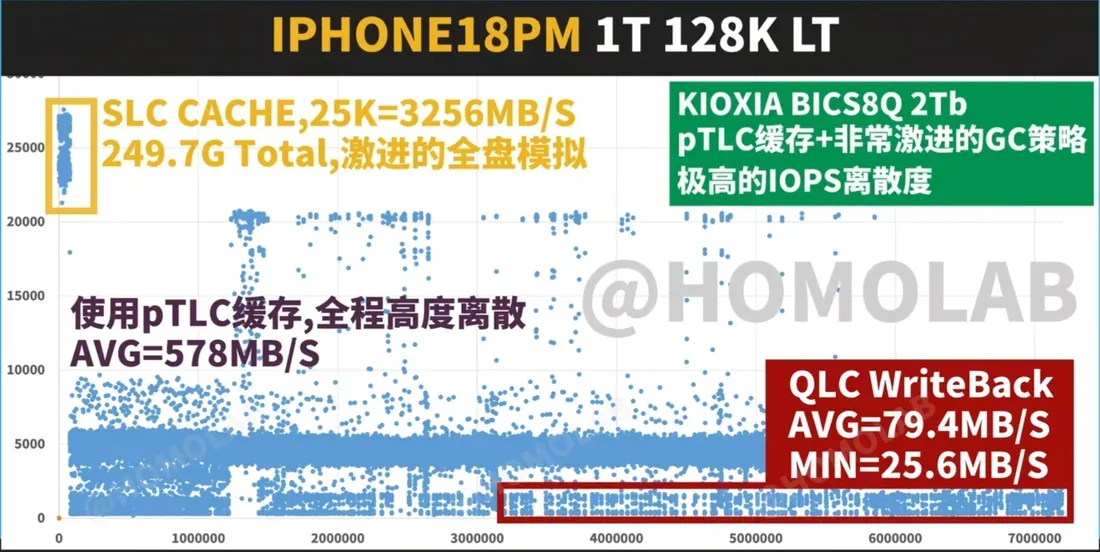
Like many modern mobile devices, the iPhone 18 Pro Max attempts to mask the slower nature of QLC storage by using a small, fast single-level cell (SLC) cache. This cache acts as a temporary buffer to absorb quick bursts of data, allowing the phone to reach write speeds above 3,000 MB/s as long as the cache has open space.
Once this high-speed cache is exhausted during prolonged write operations, the phone falls back to a secondary buffer that simulates TLC storage. While this secondary buffer is slower than the SLC cache, it still manages to maintain a decent average speed of 578 MB/s, albeit with substantial performance variation.
The real trouble begins when both the SLC cache and the secondary buffer are completely filled. At this point, the phone is forced to write data directly to the raw QLC storage. During these sustained write-back phases, HOMOLAB measured sustained write speeds dropping to an average of just 79.4 MB/s, occasionally bottoming out at a mere 25.6 MB/s. This level of performance is slower than many budget microSD cards.
What Happens When the Drive Fills Up
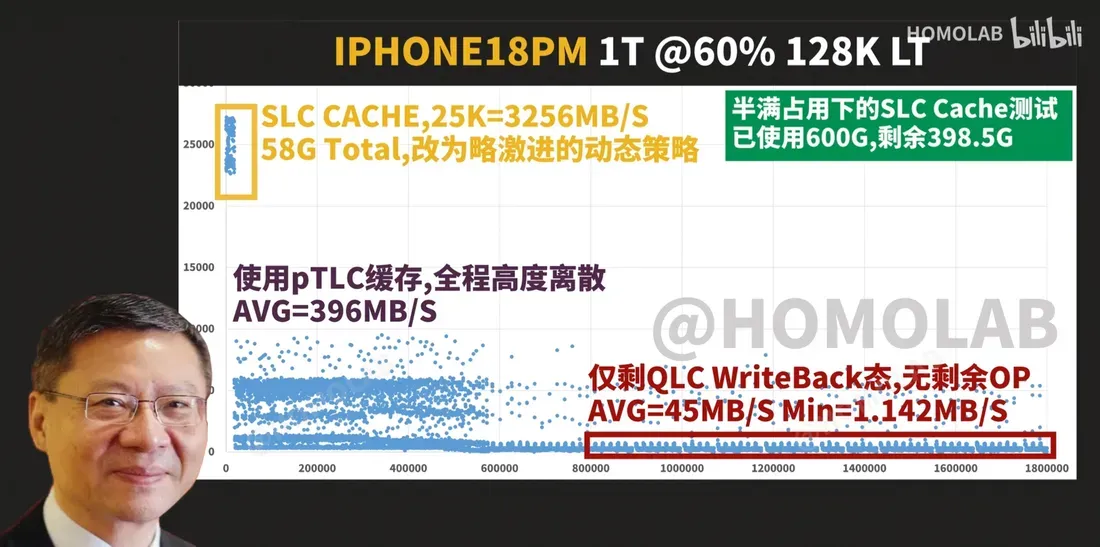
The performance bottleneck becomes even more severe as the storage drive fills up with photos, apps, and videos. When the 1TB iPhone 18 Pro Max was tested at 60 percent storage capacity, the reduced free space left far less room for the high-speed cache to operate.
At this capacity, the available SLC cache dropped sharply from approximately 250GB on an empty drive to just 58GB. Furthermore, the secondary TLC-simulating buffer slowed down to an average of 396 MB/s. Most concerningly, the raw QLC write-back stage degraded even further, averaging just 45 MB/s and bottoming out at an incredibly slow 1.1 MB/s.
This extreme slowdown puts the premium iPhone well behind competing Android flagship phones that utilize TLC-based UFS 4.0 storage solutions, which maintain much higher write speeds under similarly heavy workloads.
Who This Storage Slowdown Actually Affects
For the vast majority of everyday tasks, such as texting, web browsing, and taking casual photos, this storage limitation will remain completely invisible. The built-in SLC cache is more than capable of handling these short, intermittent bursts of data without breaking a sweat.
However, the slowdown becomes a genuine issue during sustained heavy writes. This includes scenarios like recording long 4K or ProRes videos, transferring massive files to and from an external drive, or restoring a massive system backup. Ironically, these are precisely the heavy-duty tasks that power users and creative professionals buy the expensive 1TB storage tier to perform. Paying a steep price premium for a high-capacity model only to receive slower sustained performance than a lower-capacity counterpart represents a frustrating engineering compromise.