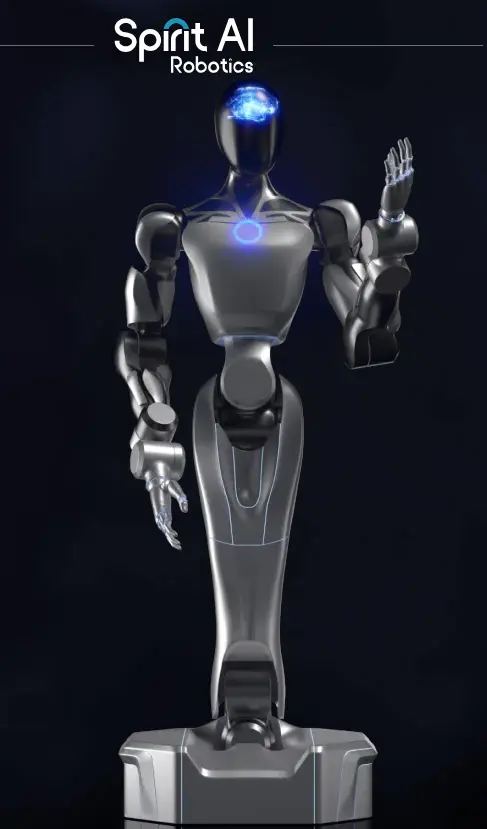
Robots are becoming smarter, and a Chinese startup just took the lead in teaching them how to act in the real world. Spirit AI’s model Spirit v1.6 scored 1,924 on the RoboArena benchmark, beating NVIDIA’s Cosmos3-Nano-Policy at 1,881 and DreamZero at 1,763. This is the first time a Chinese embodied AI model has topped this respected test.
- Spirit AI’s model outperforms NVIDIA’s top robots on RoboArena
- RoboArena tests AI’s ability to perform real-world robotic tasks
- China is gaining ground with strong robotics data and funding
- Spirit AI raised about $222 million to boost its AI robotics
What makes RoboArena a tough test for AI robots
RoboArena measures how well AI systems turn decisions into physical actions, like moving objects, navigating spaces, using tools, and adapting to new environments. Unlike many AI benchmarks that focus on language or reasoning, RoboArena tests real-world robotic skills in randomized and challenging scenarios. This makes it hard for companies to simply optimize for the test, ensuring the AI is genuinely capable.
The rise of physical AI beyond chatbots
While chatbots have grabbed headlines, the AI race is moving into the physical world. Embodied AI powers robots, autonomous vehicles, and industrial machines that need to understand and interact with their surroundings. Spirit AI’s success shows that smart model design and quality training data can be as important as sheer computing power. Their model excelled at object handling, autonomous navigation, and tool use, adapting quickly with little fine-tuning.
China’s growing edge in robotics and AI
China’s robotics sector is booming. Besides Spirit AI, companies like Manifold AI, AgiBot, and DexForce are leading in world modeling, perception, and data generation for robots. Spirit AI recently secured about $222 million in funding, reflecting strong investor confidence. This growing strength in data, funding, and benchmark performance signals an increasingly competitive global robotics landscape.
For anyone interested in how AI is shaping the future of robots and automation, Spirit AI’s breakthrough suggests practical advances are happening fast. The focus on real-world robotic abilities means these technologies could soon impact everyday life, from manufacturing floors to smart homes.
Via: Gizmochina