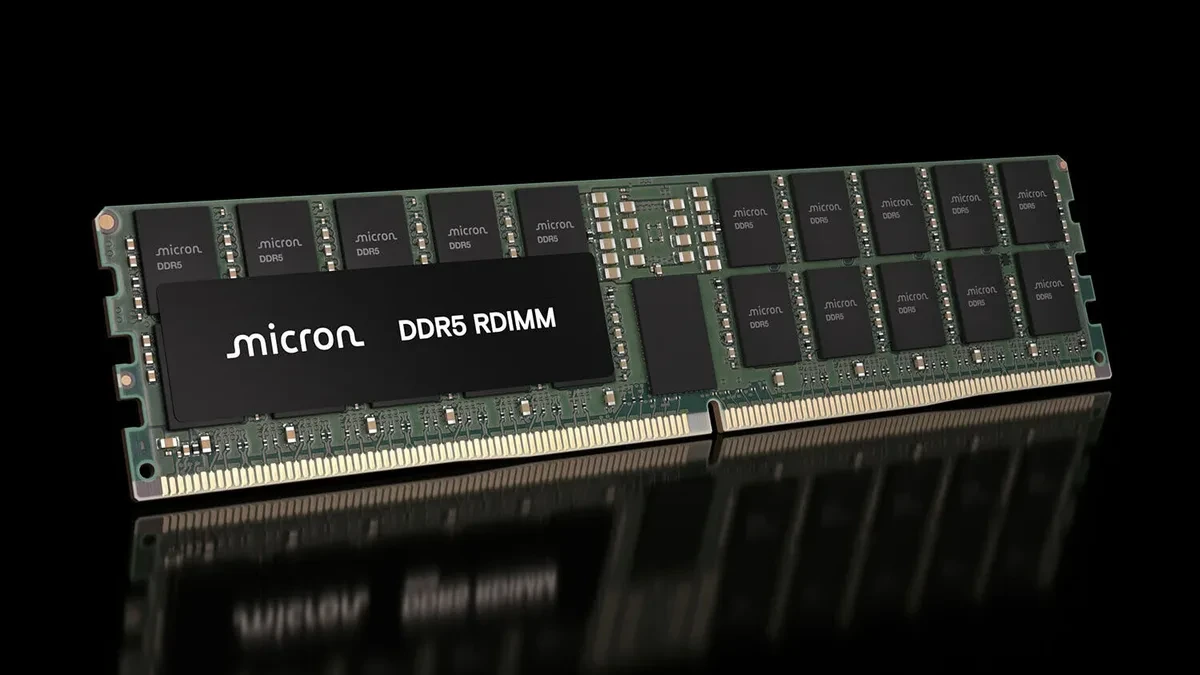
Data centers handling large language models and real-time analytics face an ongoing bottleneck: physical memory density and thermal power draw. Micron has revealed a single 512GB DDR5 RDIMM server memory module designed to eliminate those constraints, reaching transmission speeds of up to 9,200 MT/s while consuming significantly less power than traditional multi-stick setups.
By vertically stacking DRAM dies using through-silicon vias (TSVs), Micron allows enterprise servers to scale system memory up to 12TB in standard dual-socket configurations. While volume production is slated for the second half of 2027, both AMD and Intel are actively validating the hardware for their next-generation server platforms. Official enterprise pricing has not yet been announced.
Eliminating the Multi-Stick Power Trap
In high-density server environments, achieving half a terabyte of RAM per node previously required populating four separate 128GB memory slots. That approach creates substantial thermal overhead and electrical drag across the motherboard trace routing. Micron solves this efficiency deficit by consolidating 512GB into a single registered DIMM (RDIMM).

The power metrics highlight the engineering advantage: a single 512GB RDIMM is rated at just 16 watts, compared to 44.2 watts for four 128GB modules providing the equivalent total capacity. This delivers an operational power reduction of more than 60 percent. In a modern data center deploying thousands of server racks operating around the clock, that energy difference drastically lowers utility overhead and simplifies cooling infrastructure.
Hardware Architecture and Workload Scaling
The 512GB capacity is achieved through vertical die stacking connected with Through-Silicon Vias (TSVs), allowing Micron to pack maximum density into a standard DIMM footprint without exceeding physical server height limitations. On a dual-socket server equipped with 24 memory slots, this design expands maximum system memory to 12TB of high-speed DDR5 RAM.
This massive memory pool directly benefits memory-bound enterprise workloads that require entire datasets to remain active in memory rather than shuttling data across slower NVMe storage arrays. Micron points to key performance gains in Spark SVM-based data analytics, where the 512GB RDIMM delivers up to 1.4 times the throughput of systems running 256GB DDR5 configurations. Similar performance gains are expected for in-memory key-value databases like Redis and RocksDB, enabling higher concurrency and lower query latency under heavy concurrency loads.
Ecosystem Validation and Delivery Timeline
Hardware adoption at this scale requires close collaboration with major processor vendors. Both AMD and Intel are currently validating Micron's 512GB DDR5 RDIMMs across their upcoming enterprise CPU platforms to ensure full architecture compatibility and timing stability at 9,200 MT/s speeds.
Micron expects to enter volume production during the second half of 2027, aligned with customer demand and server deployment schedules. As AI model parameter sizes continue to swell beyond standard platform limits, high-density, low-power memory modules will become an essential component of efficient data center infrastructure.