A fresh Geekbench listing has revealed Qualcomm's upcoming flagship silicon, internally designated as SM8975 and expected to launch as the Snapdragon 8 Elite Extreme Gen 6, running inside an unreleased performance tablet. Spotted under Vivo model number iPA2691, the device corresponds to China's upcoming iQOO Pad Ultra, pairing a 2nm architecture with peak CPU clock speeds reaching an eye-catching 5.01GHz ahead of its scheduled late-September debut in China.
Despite the high clock speeds on paper, the benchmark tally tells a surprisingly modest story. The prototype registered 1,512 points in single-core evaluation and 6,770 points in multi-core testing on Geekbench 7, figures that sit substantially below current flagship silicon standards. However, rather than pointing to fundamental hardware flaws, the discrepancy highlights the classic gap between early pre-release engineering builds and finalized production hardware.

The Architecture Behind Qualcomm's 5.01GHz Silicon
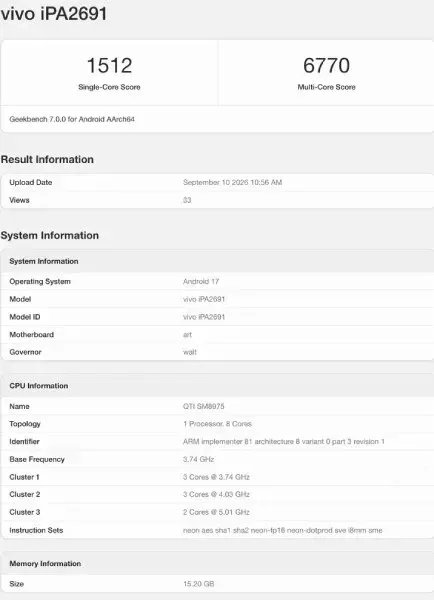
The Geekbench listing provides a detailed look at the SM8975 core cluster arrangement. Manufactured on an advanced 2nm node, the processor utilizes an eight-core CPU topology divided into three distinct clusters: three efficiency cores running at 3.74GHz, three intermediate performance cores clocked at 4.03GHz, and two top-tier prime cores scaling all the way up to 5.01GHz. Graphical rendering is managed by Qualcomm's Adreno 850 GPU, backed by 16GB of system memory and an operating environment built on Android 17.
Pushing mobile processor clocks past the 5.0GHz threshold represents a notable milestone for mobile architecture, yet raw clock speed alone cannot guarantee high benchmark outputs if the firmware actively restricts thermal envelopes. In prototype stages, test silicon frequently operates under conservative power profiles, aggressive under-voltage constraints, or unfinished memory controller drivers designed primarily to log stability rather than break performance records.

Active Cooling Hardware and the Road to Launch
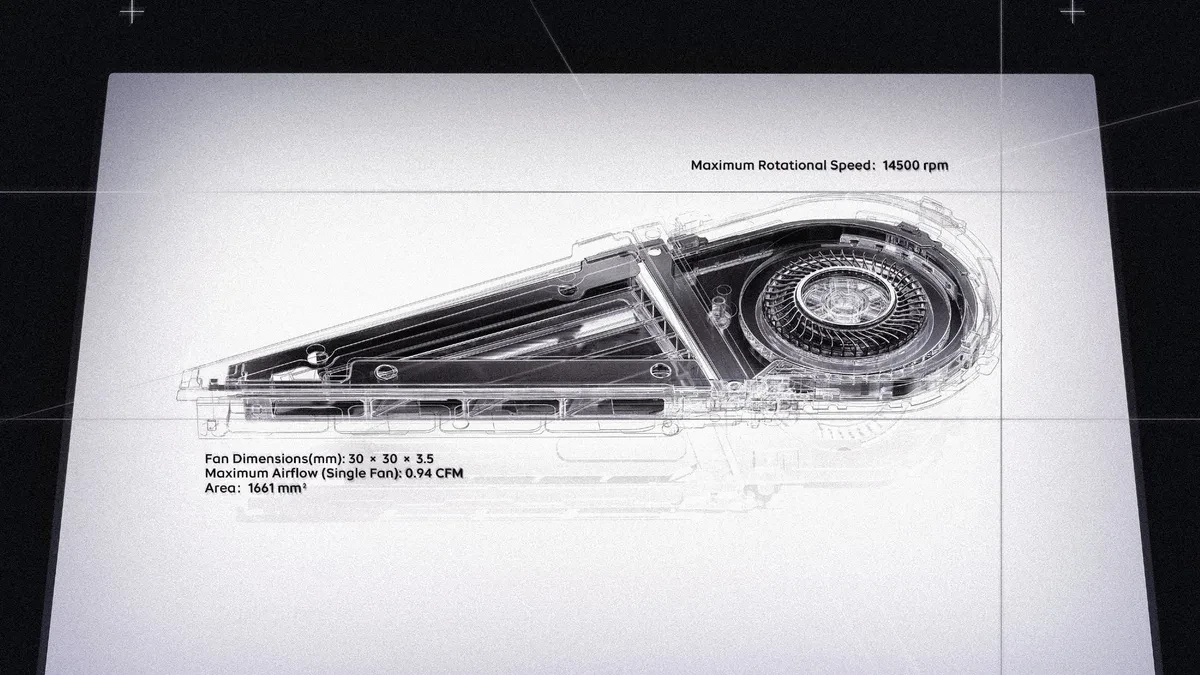
Sustaining such aggressive frequencies inside a tablet form factor requires serious thermal management. To address heat dissipation, iQOO has already confirmed that the Pad Ultra incorporates an active internal cooling fan capable of spinning up to 14,500 rpm. The fan is housed inside an ultra-compact module measuring 30 x 30 x 3.5mm, engineered to exhaust heat during prolonged sustained workloads like gaming or continuous rendering.
Because the test listing represents an unreleased device running pre-commercial software, commercial retail units are expected to post drastically different numbers once final kernel drivers, GPU firmware, and dynamic fan curves are deployed. With the iQOO Pad Ultra slated to launch in China toward the end of September, real-world retail testing will soon reveal whether Qualcomm's 5GHz mobile silicon can deliver on its ambitious paper specifications.