
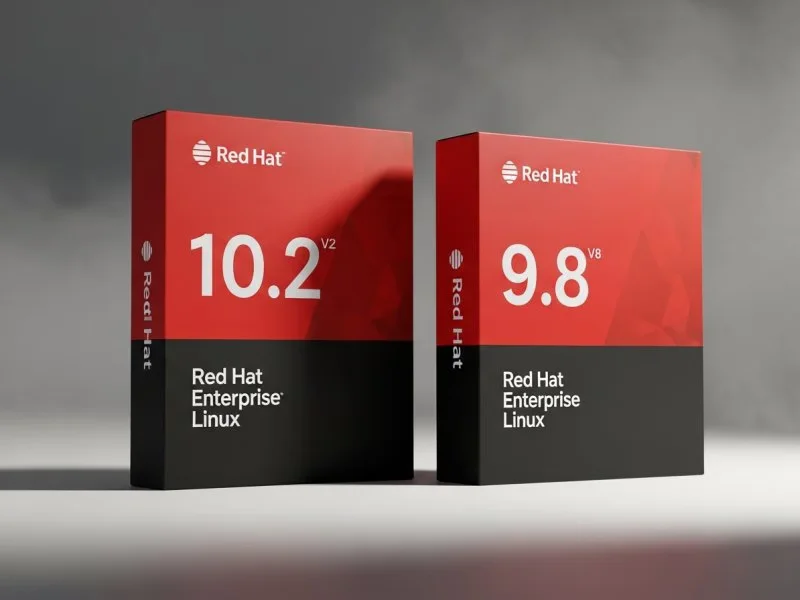
Managing hybrid cloud environments often involves juggling complex tools and security concerns. Red Hat Enterprise Linux (RHEL) 10.2 and 9.8 tackle these issues by integrating AI directly into their core management interfaces, aiming to simplify routine tasks while strengthening security.
The updates introduce an AI assistant named “gooes” that works within the command-line interface to provide quick access to commands and insights. This cuts down the need to consult external manuals or online resources, allowing administrators and developers to work more efficiently.
- AI assistant embedded in the command line for faster workflows
- New bootable container image mode streamlines OS deployment
- Quantum-resistant certificate system automates security
- Updated developer toolsets improve coding environments
AI Assistance Streamlines Command-Line Operations
Unlike traditional Linux distributions where users often switch between terminal and documentation, RHEL’s gooes AI assistant offers contextual help and command suggestions directly in the CLI. Enhanced color output further improves readability, making interactions smoother for system administrators.
Automated Deployment With Bootable Container Images
RHEL now supports bootable container image mode, reducing manual steps involved in OS installations. This feature pairs with an upgraded image builder command and system role enhancements, helping teams automate deployments consistently across hybrid environments.
Security Upgrades Address Future Quantum Risks
The rise of quantum computing threatens current cryptographic standards. To prepare, RHEL includes Red Hat Certificate System 11.0, which complies with new NIST standards (FIPS 204) for quantum-resistant algorithms. This system automates certificate issuance with zero-touch provisioning and secure one-time passwords, easing the administrative burden while boosting security.
Developer Tools Are Updated for Modern Workflows
Developers get access to LLVM Toolset 21, Go 1.26 with new garbage collection, Rust 1.92, Python 3.14, and other languages updated to the latest stable versions. These updates help maintain compatibility with modern software stacks and improve performance.
The Upgrade Process Gains AI-Powered Automation
RHEL simplifies migrations with Leapp, a tool that allows single-command upgrades to newer major versions. Additionally, the Ansible Automation Platform uses AI guidance to delegate upgrade tasks to appropriate teams, reducing human error and accelerating rollout.
The trade-off is complexity. Integrating AI and advanced automation requires administrators to familiarize themselves with new tools and workflows. However, these improvements make more sense for enterprises aiming to reduce manual overhead and improve security in hybrid cloud setups.
Prices and availability for RHEL subscriptions vary by region and organizational needs. Consider it if you manage hybrid or multi-cloud environments requiring robust security and automation. Skip it if your setup is simple or if you prefer minimal AI integration for command-line workflows.
(Via)