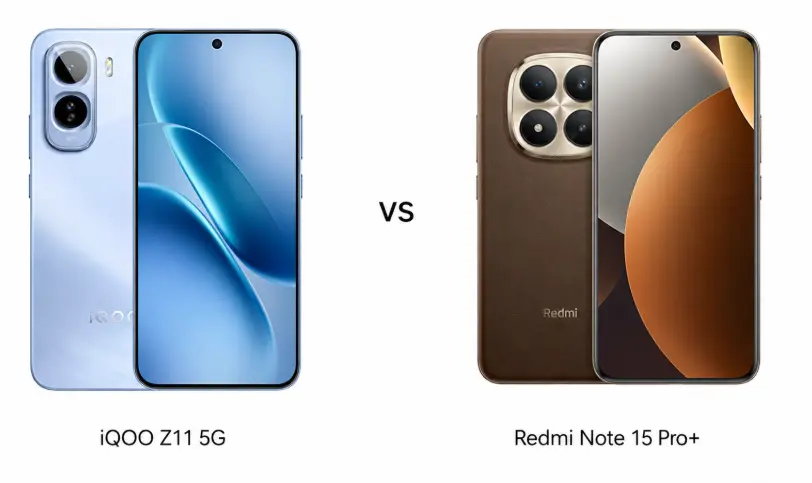
The iQOO Z11 5G and Redmi Note 15 Pro+ are duking it out in the upper mid-range segment — but they’re playing very different games. One targets marathon battery life and gaming fluidity, the other bets on camera prowess and multimedia refinement.
- iQOO Z11 5G packs a massive 9020mAh battery with 90W charging and a 144Hz AMOLED display.
- Redmi Note 15 Pro+ offers a 200MP main sensor, Dolby Vision HDR, and Gorilla Glass Victus 2 protection.
- Both run Snapdragon 7s Gen 4 with Adreno 810 GPU — performance is close but storage tech differs.
- iQOO leans toward gamers and power users; Redmi targets balanced users craving camera and design.
Flagship Power, Mid-range Compromises
Design-wise, the iQOO Z11 5G is all about practicality — IP68/IP69-rated durability, a matte finish that won’t scream premium but should survive daily abuse, and a design tuned for gamers. Redmi Note 15 Pro+, on the other hand, leans into flagship-lite territory with Gorilla Glass Victus 2, eco-leather or glass-style backs, and better drop resistance. The Redmi simply looks and feels like a pricier phone.
Both phones have water and dust resistance, but Redmi’s extra armor gives it an edge for long-term durability. Meanwhile, iQOO’s aggressive styling is a clear nod to younger, gaming-first users.
Display Battles: Smoothness vs Cinematic Flair
The iQOO Z11’s 144Hz AMOLED panel hits a peak brightness that’s eye-watering at 5000 nits, promising ultra-smooth scrolling and gaming. The Redmi Note 15 Pro+ counters with Dolby Vision and HDR10+, deeper color depth, and more cinematic punch during video playback.
What this means: if you want buttery smooth gameplay, iQOO is your pick. For richer media consumption, Redmi offers a more refined display experience.
Snapdragon 7s Gen 4: Close on Paper, Different in Practice
Under the hood, both phones share the Snapdragon 7s Gen 4 chipset and Adreno 810 GPU. Daily tasks and gaming should feel similarly smooth. The differentiator is storage: iQOO’s UFS 3.1 promises faster app loading and better responsiveness versus Redmi’s UFS 2.2 — a curious downgrade for a pricier phone.
Software philosophies diverge. iQOO’s Origin OS pushes performance and speed, while Redmi’s HyperOS 2 focuses on polish and ecosystem integration. Gamers will likely gravitate toward iQOO’s aggressive tuning.
Three Hours to Full Charge? That’s the Trade-off
Battery is iQOO’s trump card. Its massive 9020mAh silicon-carbon cell outlasts the Redmi’s 6500mAh by a significant margin. Even with heavy gaming or streaming, iQOO should keep going when Redmi is begging for a charge.
Charging speeds are close: Redmi’s 100W charging edges out iQOO’s 90W, but real-world difference won’t be dramatic. You’ll be plugging in less often with iQOO, but when you do, the wait times are comparable.
Camera Showdown: Versatility vs Simplicity
The Redmi Note 15 Pro+ takes a clear lead with its 200MP main sensor, OIS, and dedicated ultrawide lens. Photos will have better detail, dynamic range, and flexibility. Dolby Vision display tuning also helps photos and videos pop during playback.
The iQOO Z11 sticks to a dual-camera setup with a 50MP primary sensor and no ultrawide. It’s functional for daylight shots but doesn’t aim to impress. For selfies, both offer 32MP front cameras, but iQOO adds 4K selfie video recording — a small win for content creators.
Price Tags That Shift the Value Equation
iQOO Z11 5G is priced aggressively around $300 (₹31,000), offering massive battery life and smooth display performance. Redmi Note 15 Pro+ demands about $360 (₹34,500) but offers a more premium build, better cameras, and richer multimedia features.
In short: iQOO is a bargain for gamers and power users who can sacrifice camera versatility. Redmi is worth the extra cash if you want a more complete package.
The Big Picture
This matchup highlights a growing mid-range trend: phones splitting between niche specialization and balanced all-rounders. iQOO Z11 5G is a battery marathoner with gaming chops, appealing to users who hate charging and prioritize raw endurance. Redmi Note 15 Pro+ leans into flagship-lite territory with camera muscle and multimedia polish.
For buyers, the choice boils down to priorities. You want to game hard and go long? iQOO’s your phone. You want a phone that handles photos, video, and daily use with fewer compromises? Redmi is the smarter pick. Neither is perfect, and real-world performance will vary, but this rivalry sharpens the mid-range field — forcing brands to pick sides rather than chasing a one-size-fits-all fantasy.
(Via)