
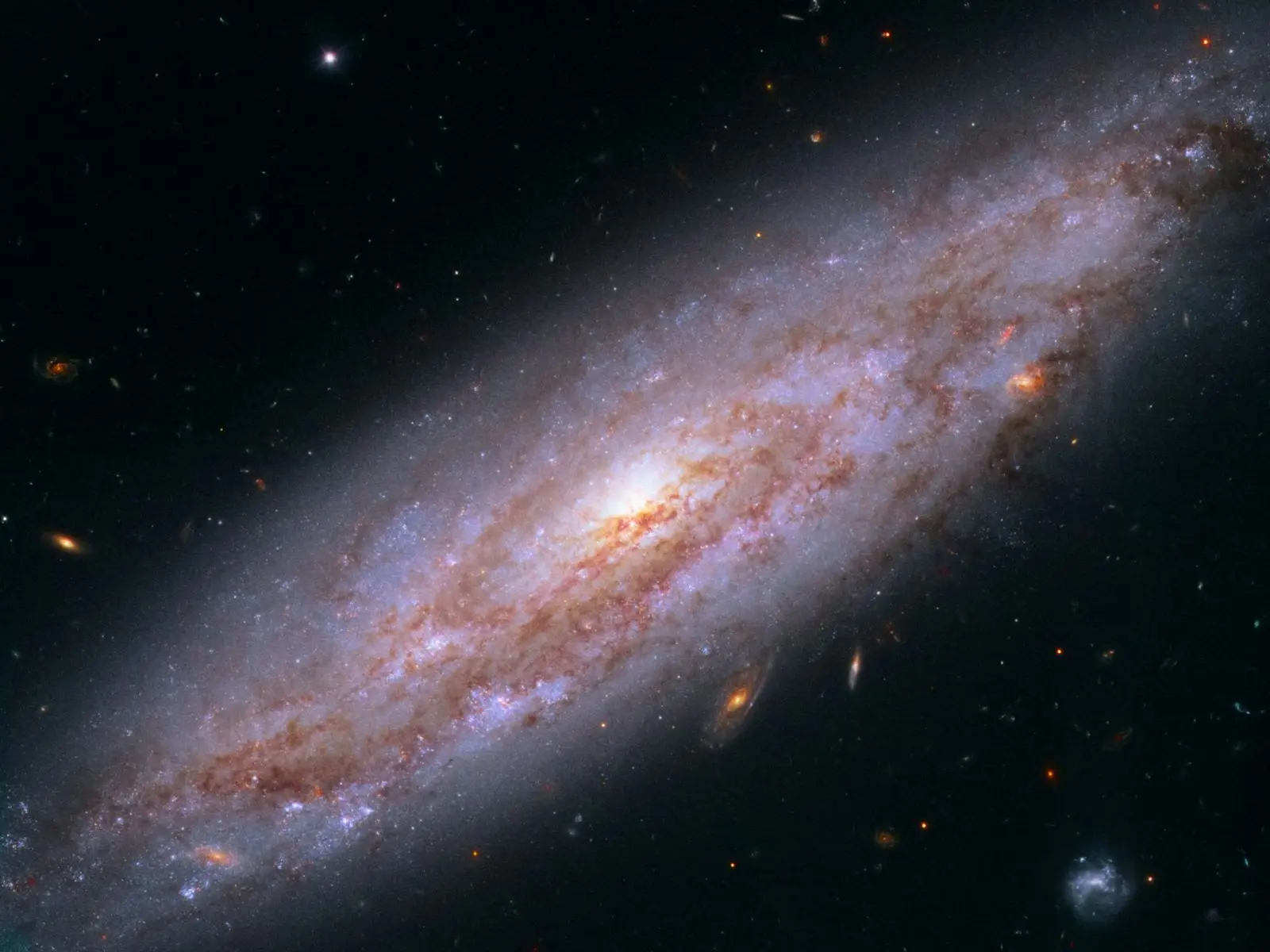
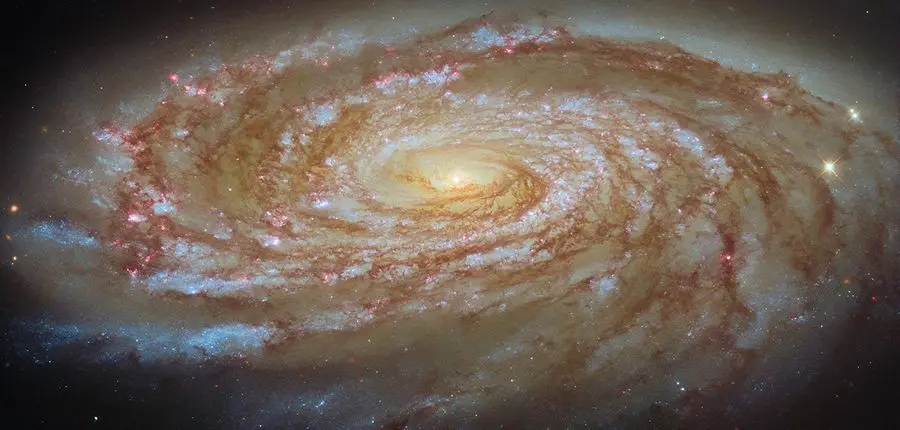
The Hubble Space Telescope has recently captured an extraordinary image of M88, a spiral galaxy located approximately 63 million light-years from Earth. This galaxy, spanning about 121,000 light-years in diameter, is part of the Virgo Cluster, a massive assembly of over a thousand galaxies bound by gravity.
- M88 is a spiral galaxy situated 63 million light-years away within the Virgo Cluster.
- The galaxy features a luminous center caused by stars orbiting a supermassive black hole estimated at 100 million solar masses.
- Its symmetrical spiral arms contain clusters of pink and blue stars alongside dust clouds.
- In 200 to 300 million years, M88 is projected to approach M87, an elliptical galaxy with a much larger black hole, leading to significant changes in M88’s structure and star formation capabilities.
Illuminating the heart of M88
The central brightness in the Hubble image is due to a dense group of reddish stars orbiting a supermassive black hole. This black hole’s mass is estimated to be around 100 million times that of our Sun, making it a dominant gravitational force at the galaxy’s core. Such intense gravitational pull influences the motion of nearby stars and the dynamics of the galactic center.
The spiral arms and their stellar composition
M88’s spiral arms are a defining feature, showcasing a striking symmetry. These arms are dotted with clusters of pink and blue stars, which indicate regions of active star formation and young stellar populations. The presence of dust clouds further enriches the galaxy’s complex structure, affecting both light absorption and star formation processes.
Future interactions within the Virgo Cluster
The Virgo Cluster is a dense region with galaxies orbiting its center. Astronomical projections suggest that in 200 to 300 million years, M88 will pass close to M87, an elliptical galaxy known for harboring a supermassive black hole approximately 6.5 billion times the mass of the Sun. This close encounter is expected to eject gas from M88 and dramatically alter its shape. Such interactions have significant consequences, potentially disrupting star formation and changing the galaxy’s evolutionary path.
The fate of M88 exemplifies the dynamic and sometimes violent nature of galaxy clusters, where gravitational forces can reshape galaxies over cosmic timescales. These processes also highlight the complex interplay between black holes, stellar populations, and galactic structures in the universe’s grand tapestry.
Via: Notebookcheck