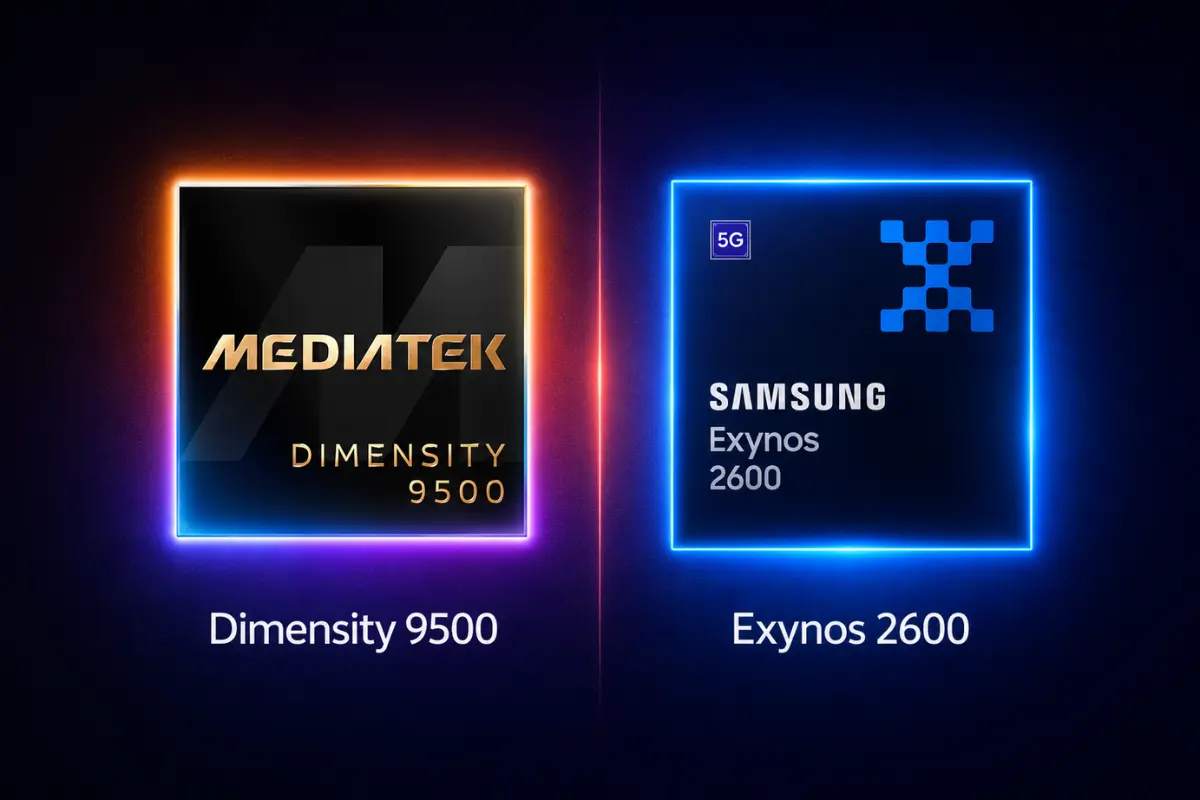
MediaTek’s Dimensity 9500 and Samsung’s Exynos 2600 are positioned as flagship smartphone chipsets, but the real question is: how much do these specs translate to tangible user benefits? This battle is crucial because it pits MediaTek’s latest 3nm chip against Samsung’s new 2nm design and an all-big CPU core setup.
- Dimensity 9500 uses TSMC’s 3nm process with an 8-core CPU, including high-performance cores.
- Exynos 2600 is the first 2nm smartphone processor with an all-big 10-core CPU but skips premium cores.
- Dimensity leads in GPU performance and gaming stability, while Exynos shines in AI and 5G download speeds.
- Camera features diverge: Dimensity leans on focus-tracking for sharp shots; Exynos prioritizes real-time scene analysis and low-light video clarity.
Flagship Power, Mid-range Compromises
The Dimensity 9500 claims higher single-core Geekbench 6 scores—about 13% ahead—but the Exynos 2600 nudges past in multi-core tests. Still, the difference isn’t wide enough to sway the overall experience drastically. The catch is simple: having more cores doesn’t guarantee better performance without the right architecture. MediaTek’s inclusion of C1-Premium cores in the 9500 gives it an edge despite fewer cores.
GPU Wars: Stability vs Ray Tracing
The Dimensity 9500’s Mali-G1 Ultra GPU beats the Exynos 2600’s Xclipse 960 in most benchmarks and gaming stability metrics. The lowest loop score advantage means smoother frame rates over extended sessions. However, the Exynos 2600 supports ray tracing, which could appeal to niche users despite weaker raw performance. Don’t hold your breath for flawless thermals on the Exynos, though—Samsung’s new Heat Path Block aims to fix overheating, but real-world proof is pending.
NPU Showdown: AI Speed vs Efficiency
Both chips upgraded their AI engines significantly. MediaTek’s NPU 990 touts twice the speed and better power efficiency, capable of multi-step AI tasks and 4K image generation from text. Samsung’s Exynos 2600 NPU boasts 113% faster generative AI performance and reduced latency, focusing on enhancing video and photo processing. The takeaway: AI workloads will run fast on both, but the actual impact depends on software optimization and device integration.
Camera Capabilities: Different Priorities
Dimensity’s camera pipeline emphasizes focus-tracking at 30fps and advanced noise reduction for 200MP shots. Exynos 2600 counters with AI-powered real-time element recognition and improved low-light video clarity via Deep Learning Video Noise Reduction. If you prioritize still photography, MediaTek’s approach might produce cleaner shots; for video enthusiasts, Samsung’s AI-driven enhancements could tip the scales.
Connectivity: Speed Isn’t Everything
Connectivity is where the Exynos 2600 flexes hard: an external 5G modem hits nearly 15Gbps download speeds—double that of Dimensity 9500’s integrated modem capped at 7.4Gbps. But Dimensity 9500 leads on Wi-Fi 7 speeds, maxing at 7.3Gbps versus Exynos’s 4.9Gbps. What this actually means is that network performance will vary depending on use case and carrier infrastructure. Plus, integrated modems tend to be more power efficient and simpler to implement.
GizmoIndo’s Take
On paper, Samsung’s Exynos 2600 sounds like a step-change with its 2nm process and all-big CPU design. But the Dimensity 9500’s balanced core architecture, stronger GPU, and integrated 5G modem keep it competitive—and in some ways, ahead. The real-world difference will hinge on how OEMs optimize their devices, especially regarding thermals and software. Both chipsets push AI and connectivity forward, but don’t expect miracles from either. For consumers, this means the choice will likely come down to device ecosystem and pricing rather than raw specs alone.
(Via)