Xiaomi is making a bold play for the high-end mobile silicon market with the debut of the Xring O3. As only the second chipset developed by the company, it aims to disrupt the dominance of established players like MediaTek. By pitting the Xring O3 against the formidable Dimensity 9500, we get a clear look at how Xiaomi’s latest engineering efforts stand up against industry-standard hardware.
Initial benchmark data suggests that Xiaomi is not just participating in the high-end race, but potentially leading it. With a 3nm manufacturing process and a unique 10-core CPU configuration, the Xring O3 is designed to handle heavy multi-threaded workloads with efficiency that previous generations simply could not match.

Benchmark Performance: A Significant Leap
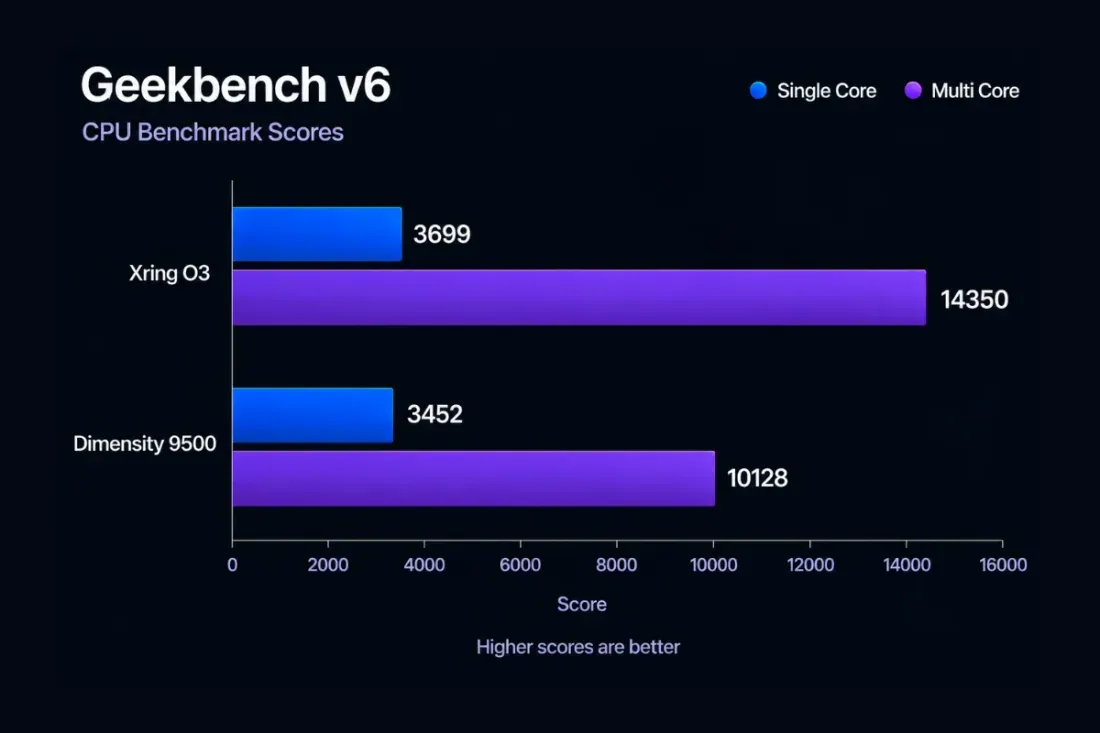
In synthetic testing, the delta between these two chips is hard to ignore. According to Geekbench 6 scores, the Xring O3 registers a single-core score of 3,699, edging out the Dimensity 9500’s 3,452 points. However, the real story unfolds in multi-core performance, where the Xring O3 achieves 14,350 points compared to the 10,128 points of the Dimensity 9500. This 41% performance gap highlights the advantage of Xiaomi’s additional core count for demanding tasks like video rendering and multitasking.
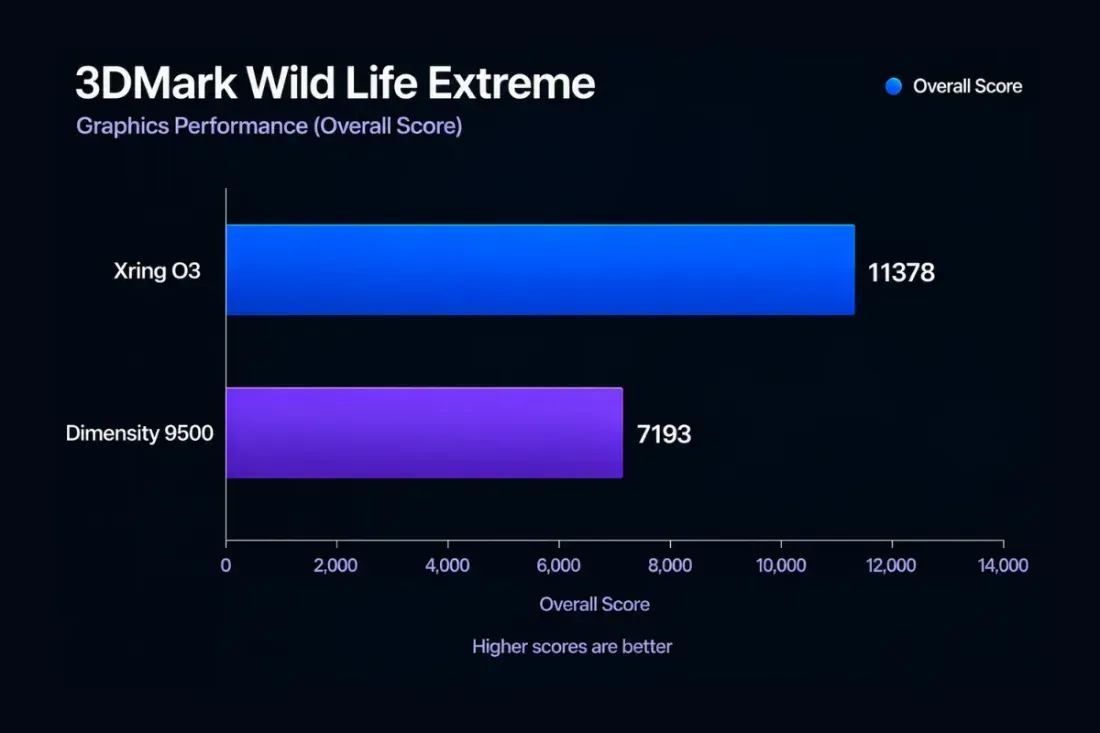
The graphical prowess of the Xring O3 is even more pronounced. During the 3DMark Wild Life Extreme stress test, which pushes thermal and graphical limits, the Xring O3 hit a score of 11,378, comfortably outpacing the Dimensity 9500’s 7,193 points. This 58% performance advantage indicates that the Xring O3 is better equipped for sustained gaming sessions at high frame rates.
Architecture and Hardware Advantages
Beyond the raw scores, the architectural choices explain why the Xring O3 holds the upper hand. While both chips use C1-series cores, the Xring O3 utilizes a 10-core setup, adding an extra C1-Ultra core and an additional C1-Premium core compared to the 8-core layout of the Dimensity 9500. These cores are also clocked at higher frequencies, providing more headroom for peak performance.
Graphics are handled by the 16-core Mali-G2 Ultra NX GPU, which includes 8 dedicated neural network units. These units facilitate AI-driven frame generation and upscaling, allowing games to run at internal resolutions that preserve battery life without sacrificing visual fidelity. Furthermore, the adoption of LPDDR6 memory support provides a 30% increase in memory bandwidth over the LPDDR5X used in the Dimensity 9500, ensuring the GPU is never starved for data.
Availability and Market Context
For those looking to experience this hardware, the Xring O3 is currently powering the Xiaomi 18 Fold and the Xiaomi Pad 9 Pro Max. Meanwhile, the Dimensity 9500 remains a staple in popular high-end devices like the Vivo X300 Pro, Oppo Find X9 Pro, and the Vivo X Fold 6. As Xiaomi continues to refine its in-house silicon, the gap between specialized chip makers and smartphone manufacturers will likely continue to shrink, offering consumers more variety in the premium mobile space.