Asus has launched the Ascent QN10 in the United States, an ultra-compact desktop PC engineered around Qualcomm's flagship Snapdragon X2 Elite platform. Starting at $1,349.99, the micro-desktop compresses an 18-core ARM architecture into a tiny 0.7-liter chassis, delivering a direct alternative to Intel Panther Lake powered mini PCs from competitors like Lenovo and HP.
By pairing Qualcomm silicon with up to 32GB of high-speed LPDDR5X memory and an 80 TOPS Neural Processing Unit (NPU), Asus aims to set a new baseline for local artificial intelligence tasks in small-form-factor computing. The Ascent QN10 caters to developers, productivity professionals, and hardware enthusiasts seeking high multi-threaded performance and silent efficiency without occupying valuable desk real estate.
Snapdragon X2 Elite Brings Multi-Threaded Muscle
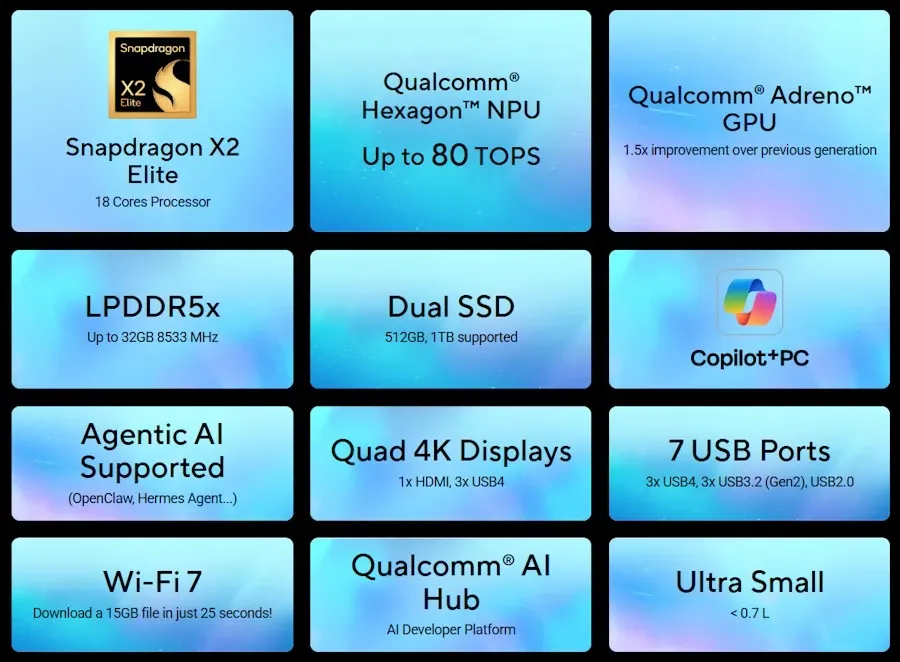
At the core of the Ascent QN10 is the Snapdragon X2 Elite X2E-88-100, featuring 18 CPU cores operating between clock speeds of 3.4 GHz and 4.7 GHz. Benchmark testing reveals that this 18-core ARM configuration achieves roughly 50 percent faster multi-threaded performance compared to the Intel Core Ultra X7 358H found in rival machines. This provides a clear computational advantage for code compilation, heavy multitasking, and multi-core data processing.

AI processing capability is another central highlight. The integrated NPU delivers up to 80 TOPS of dedicated performance, easily outpacing the 50 TOPS NPU found in Intel's Panther Lake architecture. This extra headroom accelerates local LLM execution, real-time image generation, and automated agentic AI workflows using platforms like OpenClaw directly on the machine without relying on cloud servers.
However, the transition to ARM silicon involves specific technical trade-offs. While native ARM applications run exceptionally well, legacy x86 software that relies on emulation may experience a slight drop in overall execution speed. Furthermore, the integrated Adreno X2-90 graphics processor trails behind Intel's Arc B390 GPU in raw graphics rendering, making this system better suited for compute-heavy productivity rather than high-frame-rate 3D gaming.
High-Speed Port Selection in a 0.7-Liter Enclosure
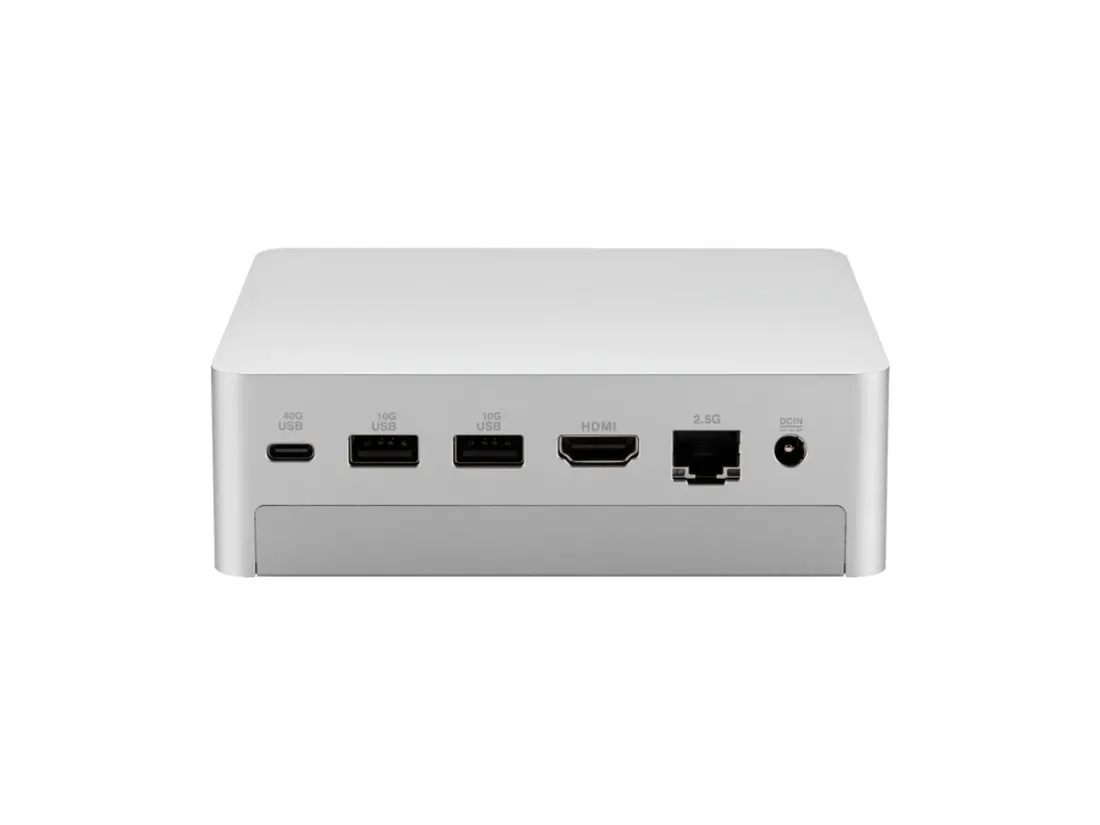
Engineering a high-performance desktop within a 0.7-liter frame requires smart thermal management and dense I/O design. The Ascent QN10 is only marginally larger than Lenovo's 0.65-liter Yoga Mini, yet Asus managed to equip the exterior with a comprehensive array of physical connectors.
Connectivity features include three 40Gbps USB4 ports for high-speed external storage or multi-monitor output, alongside three 10Gbps USB-A ports for traditional peripherals. Video output is handled via a dedicated HDMI 2.1 port, while wired network integration relies on a 2.5 GbE Ethernet jack. On the wireless side, the system is fully up to date with support for Wi-Fi 7 and Bluetooth 6.0 standard protocols.

Pricing, Configurations, and Market Alternatives
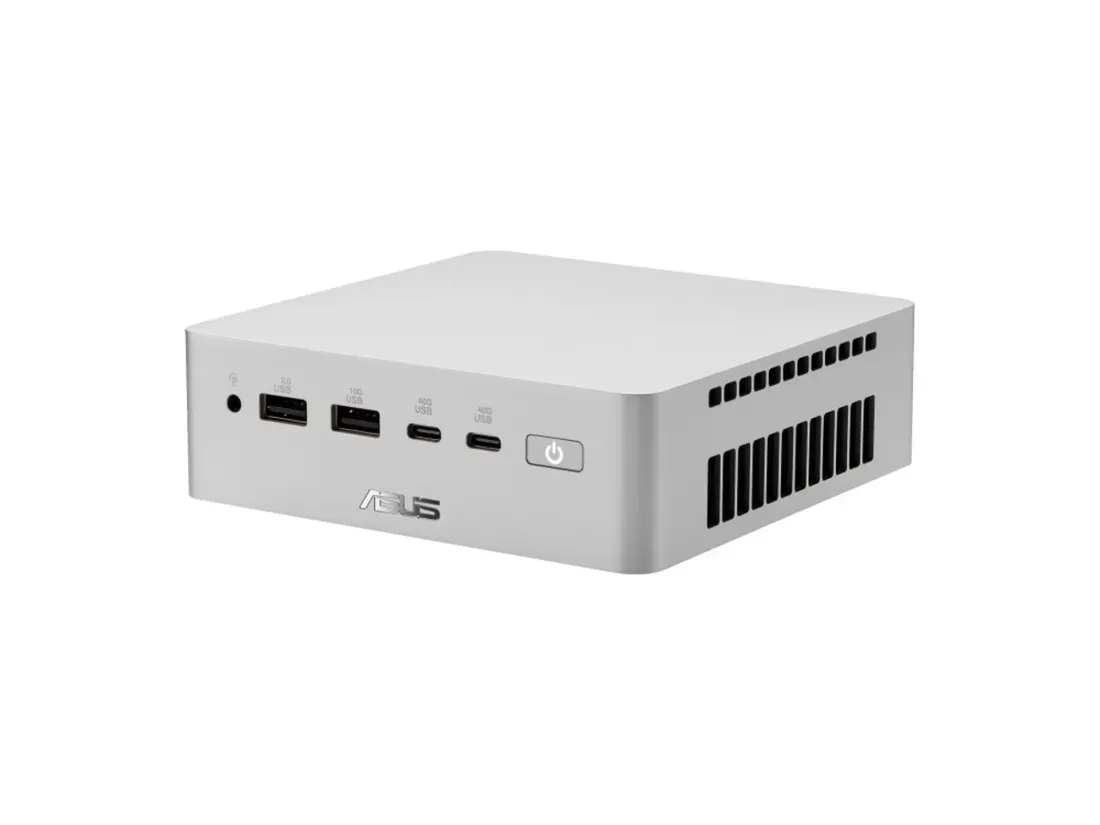
The Asus Ascent QN10 is available immediately through official retail channels in the US, including the Asus eShop, Best Buy, Amazon, Newegg, and B&H Photo Video. Pricing starts at $1,349.99 for the entry configuration, which includes 16GB of LPDDR5X-8533 RAM and a 512GB PCIe 4.0 x4 SSD.
For users needing higher memory bandwidth and capacity, Asus offers an upgraded $1,699 configuration equipped with 32GB of faster LPDDR5X-9600 memory alongside a 512GB PCIe 4.0 SSD. Both variants maintain a lower price barrier than direct Intel-based competitors.
For context, Lenovo's Yoga Mini with a Core Ultra X7 358H CPU and 32GB of RAM retails for $1,869.99, though it does ship with a larger 1TB internal SSD. Meanwhile, the HP OmniDesk Mini featuring the same Intel processor costs $1,509.99 with 16GB of RAM and 512GB of storage. Asus positions the Ascent QN10 as a compelling value proposition for buyers prioritizing raw multi-core horsepower and superior AI TOPS per dollar.