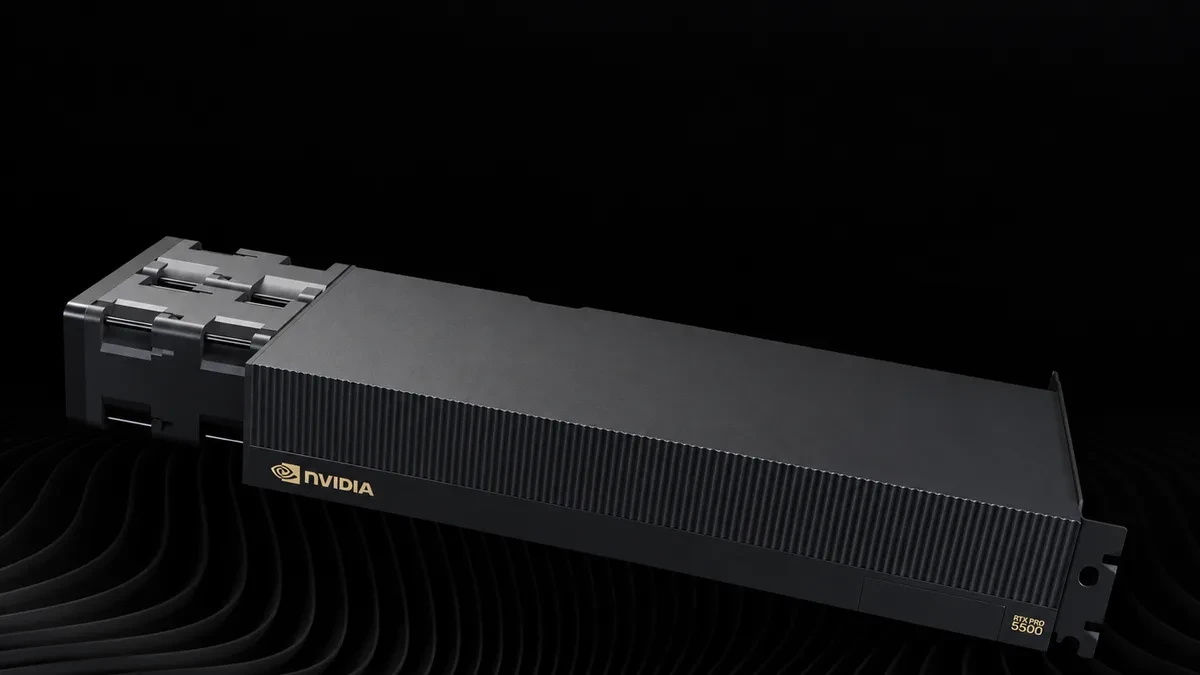
Nvidia has quietly expanded its professional GPU portfolio with the introduction of the RTX Pro 5500, a new Blackwell-based workstation card that bridges the performance gap between existing mid-range and flagship models. While the card is currently listed as coming soon without a firm retail date, early specifications provided by partners like PNY suggest a hardware configuration that leans heavily into the demands of modern AI development and complex rendering tasks.
At the heart of the RTX Pro 5500 lies a substantial 750 mm² Blackwell GPU architecture, featuring 92.2 billion transistors and 21,760 CUDA cores. This core count puts the workstation card in the same league as the highly anticipated GeForce RTX 5090, signaling that Nvidia is prioritizing raw compute power for professional workflows that require significant parallel processing capabilities.
Memory Architecture and Technical Discrepancies
The most striking feature of the RTX Pro 5500 is its 84 GB GDDR7 VRAM pool. This massive memory capacity is essential for professionals training large language models or handling massive 3D scenes that would otherwise choke standard consumer-grade hardware. However, the initial technical documentation has sparked debate among industry analysts.
While PNY lists a 416-bit memory interface, hardware experts note that this figure is mathematically inconsistent with an 84 GB capacity. A more likely configuration involves fourteen 6 GB GDDR7 memory modules, which would necessitate a 448-bit bus. This adjustment aligns closely with the reported 1,398 GB/s bandwidth, suggesting that the currently public 416-bit specification may be an error in the preliminary data sheets. Regardless of the bus width, the bandwidth on offer ensures that the massive VRAM array remains well-fed during taxing data operations.
Built for the Rack, Not the Desktop
It is important to note that the RTX Pro 5500 is not intended for the average enthusiast's desktop. The card is engineered specifically for rack-mounted workstation environments, featuring a dual-slot footprint with active air cooling. Nvidia has confirmed that a liquid-cooled variant will follow, which may be necessary to manage the thermal output of a card that draws up to 600 W under full load.
Given this power draw, the card utilizes the 12VHPWR connector. While this connector has faced scrutiny in the past due to reported failures under extreme stress, its inclusion here implies that users will need to ensure their workstation power supplies are robust and properly ventilated. The card also supports PCIe 5.0 x16 and includes three ninth-generation Nvenc encoders and three sixth-generation Nvdec decoders, making it a formidable tool for high-resolution video production and multi-stream transcoding.
Professional Utility and Availability
For enterprise users, the inclusion of Multi-Instance GPU (MIG) support is a major advantage. This allows the 84 GB of VRAM to be partitioned into two isolated 42 GB instances, providing flexibility for teams that need to run multiple concurrent tasks on a single physical card.
Global pricing has not yet been announced, but given the current market positioning of the RTX Pro 6000, it is safe to expect a price tag in the low five-figure range. The RTX Pro 5500 represents a significant investment for firms looking to scale their local AI inference and rendering pipelines without moving fully to cloud-based infrastructure.