MediaTek's Dimensity CX C10 Max is a premium laptop processor for Googlebooks, with global pricing not yet announced and a planned late-2026 debut. It matters because the chip combines a modern 3 nm manufacturing process, an Immortalis GPU and a 55 TOPS NPU, yet relies on older Arm CPU cores rather than the newer Lumex C1 architecture.
That combination could make the CX C10 Max an appealing foundation for thin, quiet laptops with long battery life, but the processor's CPU design raises questions about how aggressively MediaTek is challenging Intel and Qualcomm at the high end. The company says the chip will compete with Intel Panther Lake and Qualcomm Snapdragon X2 Elite processors in premium Googlebook models.
A capable platform built for thin laptops

The Dimensity CX C10 Max is the first processor in MediaTek's new Dimensity Compute Experiences family. It is manufactured using a second-generation TSMC 3 nm process, identified in the source material as likely N3E, and uses an eight-core all-big-core configuration.
Its CPU includes one Cortex-X925 running at up to 3.73 GHz, three Cortex-X4 cores and four Cortex-A720 cores. The chip also carries 12 MB of L3 cache and 10 MB of system-level cache. For everyday laptop workloads, an all-big-core design should give the processor substantial performance headroom, although the source provides no benchmark results to show how it compares with Intel's or Qualcomm's competing laptop silicon.
Memory support extends to LPDDR5X running at up to 9,600 Mbps, while storage can use UFS 4.0. Those specifications point toward compact systems where low board complexity and power efficiency matter. MediaTek specifically positions the processor for thin and potentially fanless laptops, which could appeal to users who value quiet operation during office work, browsing and video calls.

The unusual decision to skip newer Arm CPU cores
The most notable aspect of the announcement is not a missing port or a weak expansion option. It is the age of the CPU architecture. Although MediaTek is presenting the CX C10 Max as a flagship processor for a new generation of premium Googlebooks, it does not use Arm's newer C2 CPU architecture or the older Lumex C1 design.
The Cortex-X925 arrived in Arm's 2024 generation, while the Cortex-X4 and Cortex-A720 date from 2023. The arrangement also closely mirrors the CPU layout used by MediaTek's Dimensity 9400 smartphone chip from 2024. The later Dimensity 9400+ reached the same 3.73 GHz peak frequency now advertised for the CX C10 Max.
This does not automatically make the chip unsuitable for laptops. A proven design can reduce development risk, and laptop performance depends on more than core generation alone. However, using established cores means the CX C10 Max may have less architectural novelty than its premium positioning suggests. Buyers should wait for independent testing before assuming it can match newer laptop processors in sustained workloads.
More than a rebadged smartphone platform

The CX C10 Max has an especially close relative in MediaTek's laptop portfolio. The Kompanio Ultra 910, introduced for premium Chromebook Plus machines in 2025, uses the same eight CPU cores, the same 12 MB of L3 cache and 10 MB of system-level cache. It also includes an Immortalis-G925 MC11 GPU and the same NPU 890.
MediaTek has made several measurable changes. The peak Cortex-X925 speed rises from 3.62 GHz on the Kompanio Ultra 910 to 3.73 GHz. Supported memory speed increases from 8,533 Mbps to 9,600 Mbps, and claimed NPU performance climbs from 50 TOPS to 55 TOPS. In practical terms, those changes look more like an evolution of the existing laptop platform than a ground-up CPU redesign.
The chip's graphics and AI hardware may nevertheless give the platform a useful role in premium Googlebooks. Its 11-core Arm Immortalis-G925 GPU supports an internal display up to 4K at 60 Hz and two external 4K monitors. Hardware decoding covers 10-bit AV1, HEVC, AVC and VP9 video at up to 4K60, which should help with high-resolution streaming and media playback without placing the entire workload on the CPU.

AI features, cameras and connectivity

MediaTek's NPU 890 is rated for up to 55 TOPS of dense AI performance. The company says it can keep on-device Gemini features and AI agents running continuously while reducing power consumption. That could allow Googlebook manufacturers to support persistent AI functions without sending every task to the cloud, though the source does not identify specific applications or provide battery-life measurements.
An Imagiq 1090 image signal processor supports cameras up to 32 megapixels, electronic stabilisation, HDR video and automatic zoom. These capabilities are aimed primarily at video conferencing, where automatic framing and clearer HDR footage could be more useful than a high-resolution camera specification alone. The processor also supports Wi-Fi 7 and Bluetooth connectivity.
Release timing and what buyers should watch
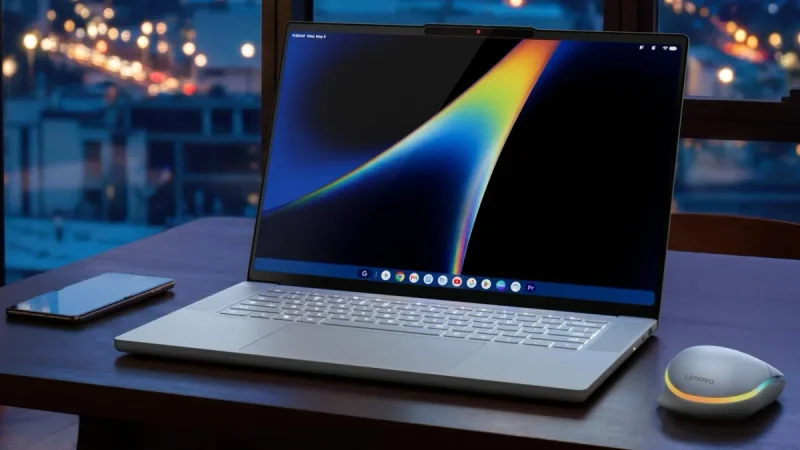
MediaTek has not identified the exact Googlebook that will debut the Dimensity CX C10 Max. The company describes the machine as a premium ultra-portable model and says the platform is intended for release in late 2026. Global pricing and regional availability have not yet been announced.
For buyers, the central question is whether manufacturers can turn this hardware into a genuinely quiet, long-lasting laptop without sacrificing application compatibility or sustained performance. The specifications suggest strong display, video, connectivity and on-device AI support, but the older CPU cores make independent benchmarks particularly important. Until those results and the first laptop designs arrive, the CX C10 Max is best viewed as a refined MediaTek laptop platform with ambitious supporting hardware, not yet a clear performance leader.