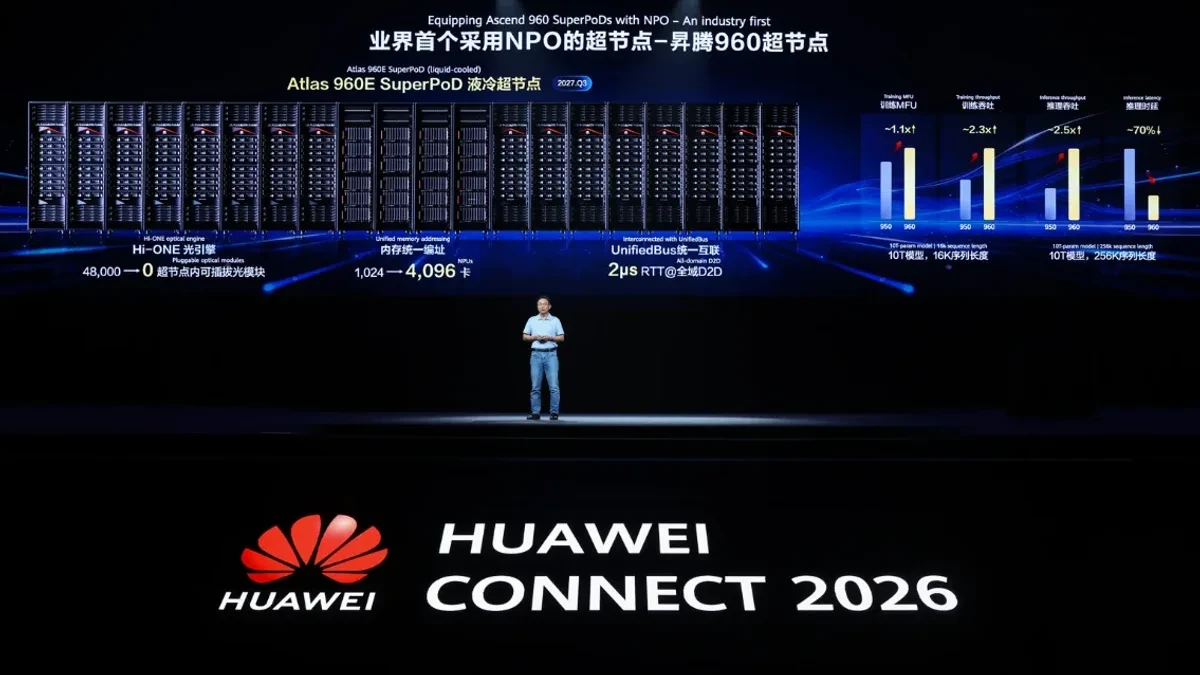
As the global demand for massive artificial intelligence models continues to outpace existing data center infrastructure, Huawei has introduced a hardware solution aimed at removing the physical bottlenecks of large-scale computing. Unveiled at the HUAWEI CONNECT 2026 event in Shanghai, the Atlas 960E SuperPoD stands out as the industry first computing architecture built on Near-Packaged Optics (NPO).
Designed to facilitate the training and inference of AI models reaching 10 trillion parameters, the system represents a significant shift in how data center components communicate. By integrating Huawei's proprietary UnifiedBus technology (Lingqu) with the new Hi-ONE optical engine, the architecture moves away from the traditional model of isolated server clusters toward a unified memory address space, effectively allowing thousands of processors to function as a single, massive compute entity.

Rethinking Optical Efficiency and Cooling
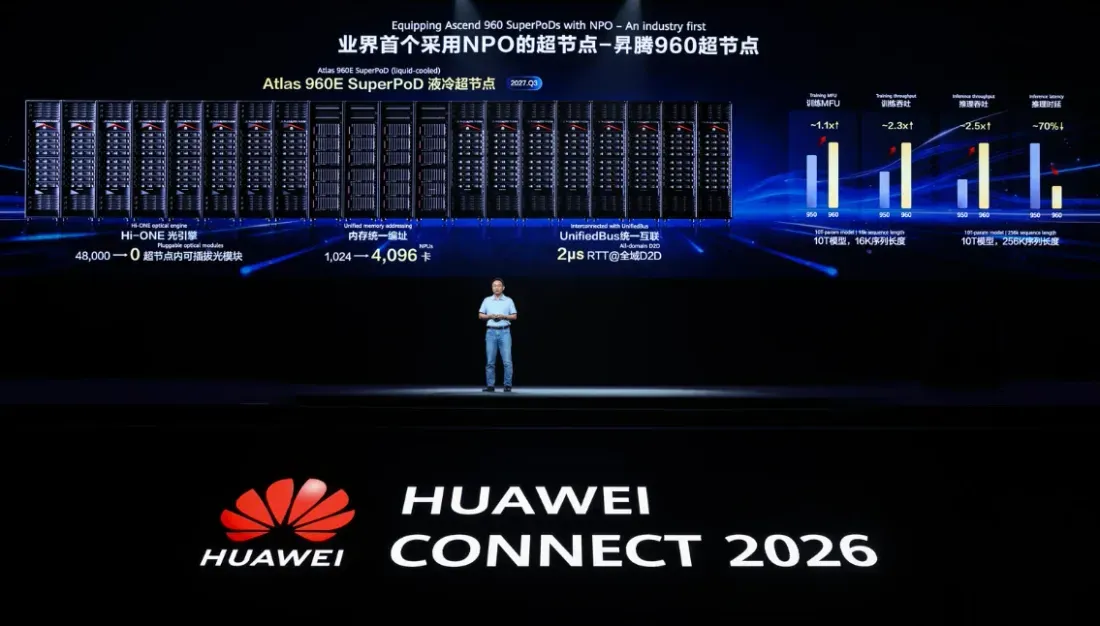
One of the most significant engineering hurdles in modern AI clusters is the sheer amount of energy spent on data transmission between chips. The Hi-ONE NPO engine addresses this by integrating the light source directly into the optical assembly. According to Huawei, this design allows the Atlas 960E to utilize roughly 5,500 Hi-ONE units, which replaces the need for approximately 48,000 traditional 800G optical modules. This reduction in hardware complexity is expected to lower power consumption by over 550 kilowatts while doubling the system's fault-free operating time.
To manage the thermal output of such high-density compute, the system employs a fully liquid-cooled design and an orthogonal architecture. This configuration allows a single SuperPoD to host up to 4,096 Ascend AI processors, delivering a theoretical peak performance of 8 EFLOPS for FP8 tasks and 16 EFLOPS for FP4 workloads. By minimizing the physical distance and complexity of optical signal paths, the system aims to achieve 99.8% availability, a critical metric for long-running training jobs that cannot afford unexpected downtime.
Scaling Toward a Million-Processor Cluster
Beyond the individual SuperPoD, Huawei is outlining a roadmap for massive, multi-rail cluster scaling. By connecting multiple Atlas 960E units through UnifiedBus and RoCE networking, the company claims it can link up to 512,000 AI processors. With the implementation of a multi-rail topology, Huawei envisions scaling an Ascend SuperCluster to a staggering 1 million processors.

This expansion is supported by the broader Ascend product roadmap. Huawei confirmed that the Ascend 960 DT is expected in Q1 2027, followed by the Ascend 960 PR in Q3 2027, coinciding with the broader rollout of the Atlas 960E. Looking further ahead, the company has signaled hardware refreshes with the Ascend 970 in 2028 and the Ascend 980 in 2029, suggesting a sustained commitment to modular, high-density AI infrastructure.
While the Atlas 960E is slated for a Q3 2027 arrival, the system represents a clear intent to challenge the current status quo of AI hardware, focusing on optical integration and unified memory as the primary levers for future performance gains.