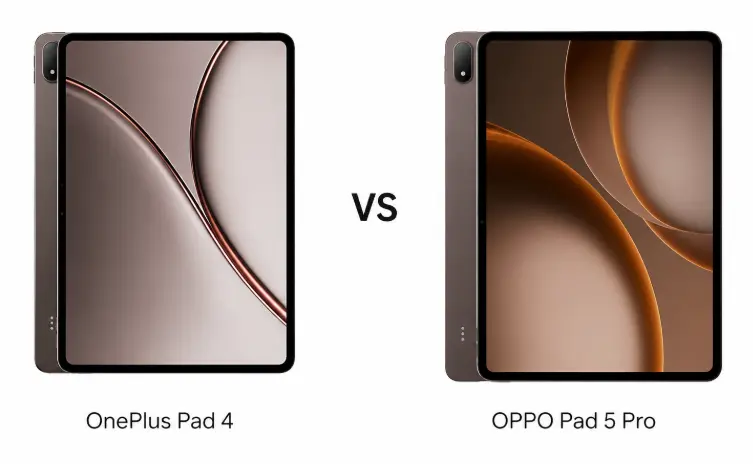
Choosing between the OnePlus Pad 4 and OPPO Pad 5 Pro means weighing subtle but meaningful differences in display quality, charging speed, software experience, and ecosystem features. Both large-screen Android tablets pack flagship Snapdragon 8 Elite Gen 5 processors and premium builds, but their unique strengths cater to different user priorities.
- The OnePlus Pad 4 offers a sharper 2400 by 3392 resolution display with Dolby Vision and Hi-Res Audio support.
- OPPO Pad 5 Pro provides more RAM options, including a 16GB variant, and strong keyboard and stylus integration for productivity.
- OnePlus charges faster with 80W wired support, while OPPO tops out at 67W.
- Pricing is close, with OnePlus around $700 and OPPO at about $650, emphasizing value versus premium features.
Design and display: premium feel meets multimedia prowess
Both tablets share slim 5.9mm aluminum bodies weighing 672 grams, balancing portability and sturdiness. The OnePlus Pad 4 edges ahead with a glass front panel and a cleaner, more refined finish that enhances its premium vibe. OPPO’s inclusion of official keyboard support integrates well with its productivity focus.
The OnePlus Pad 4’s 13.2-inch LCD display shines with a higher 2400 by 3392 resolution and Dolby Vision support, delivering sharper visuals and better HDR content. OPPO matches the 144Hz refresh rate and 1000-nit brightness but lacks Dolby Vision. Both feature eight-speaker setups, with OnePlus gaining a slight advantage from Hi-Res Audio certification, making media consumption richer and more immersive.
Performance and software: flagship power meets user preference
Under the hood, both tablets harness the Snapdragon 8 Elite Gen 5 chipset paired with Adreno 840 GPUs and UFS 4.1 storage, ensuring top-tier performance for gaming, multitasking, and creative workloads. The 144Hz displays complement this hardware with smooth navigation and responsiveness.
Software experience is where personal taste plays a key role. OnePlus’s OxygenOS 16 offers a clean, minimal interface that many find less cluttered and more straightforward. OPPO’s ColorOS 16 provides deeper customization and features, especially appealing to users already invested in OPPO’s ecosystem. Notably, OPPO offers a 16GB RAM option, which may attract power users handling intensive multitasking.
Battery, charging, and accessories: balancing endurance and productivity
Both tablets pack identical 13,380mAh batteries, promising excellent endurance for workdays and entertainment. Charging speeds differ, with OnePlus supporting 80W wired charging, enabling faster top-ups compared to OPPO’s 67W. This can be a practical advantage for users who need quick recharges.
Accessory support also divides buyers. OPPO emphasizes productivity with official keyboard and stylus support integrated into its ecosystem, enhancing multitasking and creative workflows. OnePlus supports stylus input but maintains a simpler accessory approach, focusing on a streamlined tablet experience.
Camera and media: similar hardware, subtle multimedia edge
Both tablets share identical camera setups: 13MP rear and 8MP front cameras. These are sufficient for video calls, document scanning, and casual photography but are not standout features. Video recording supports 4K at 30fps with electronic image stabilization on both devices.
Audio and video playback tilt the scale slightly towards OnePlus, thanks to Dolby Vision and Hi-Res Audio support, offering a richer multimedia experience for movies and streaming.
Pricing and final takeaways
The OnePlus Pad 4 is priced at around $700, while the OPPO Pad 5 Pro starts closer to $650. The small price gap reflects their differing priorities: OPPO’s broader RAM options and productivity-focused features versus OnePlus’s display enhancements and faster charging.
For most users, the OnePlus Pad 4’s sharper display, Dolby Vision support, faster 80W charging, and cleaner software create a more polished flagship tablet. OPPO’s Pad 5 Pro remains a strong contender for those who value productivity accessories and more customization at a slightly lower price.
Ultimately, your choice depends on whether you prioritize entertainment and streamlined software or productivity features and customization options.
Via: Gizmochina