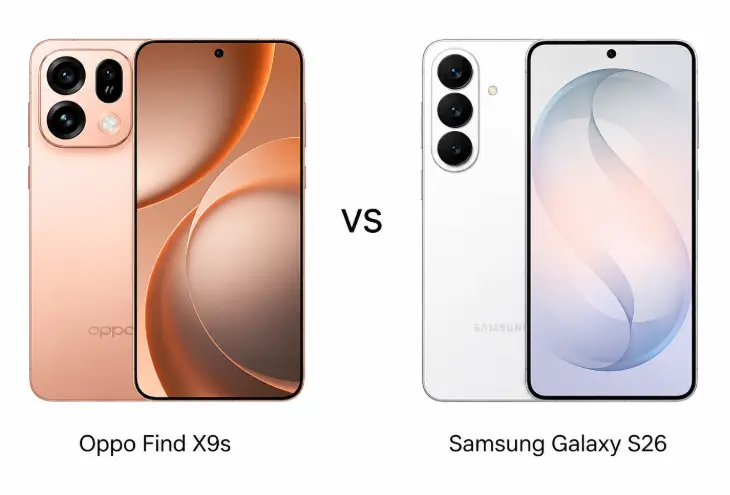
Choosing between the Oppo Find X9s and Samsung Galaxy S26 means weighing distinct philosophies in the premium smartphone arena. Oppo pushes the envelope with top-tier hardware specs, especially in battery and display, while Samsung hones in on software longevity, ecosystem perks, and a refined user experience. Both cater to premium buyers but offer contrasting strengths worth unpacking.
- Oppo Find X9s boasts a massive 7,025mAh battery with 80W wired charging and IP69 certification.
- Samsung Galaxy S26 offers up to seven years of Android updates and wireless charging support.
- Oppo’s 6.59-inch AMOLED display supports 120Hz refresh rate, Dolby Vision, and reaches 3,600 nits peak brightness.
- Samsung’s 6.3-inch Dynamic LTPO AMOLED 2X display adapts refresh rate and prioritizes color accuracy.
Design and Display: Bigger Battery Meets Refined Elegance
The Oppo Find X9s impresses with a robust glass-and-aluminum build accompanied by IP68/IP69 certifications, shielding it against dust, water, and even high-pressure water exposure. Its larger 6.59-inch AMOLED panel dazzles with 120Hz refresh rates, Dolby Vision support, and an eye-popping 3,600 nits peak brightness, delivering vivid visuals that pop especially for media enthusiasts.
Samsung’s Galaxy S26, in contrast, embraces a compact 6.3-inch Dynamic LTPO AMOLED 2X display with adaptive refresh technology, HDR10+, and Gorilla Glass Victus 2 protection. The design is minimalist and refined, aimed at users valuing portability and subtlety. While its peak brightness of 2,600 nits is lower, Samsung’s color tuning is among the industry’s best for accuracy and consistency.
Ultimately, Oppo’s display specs cater more to immersive media consumption, while Samsung balances premium feel with everyday manageability.
Performance and Battery: Power Today Versus Longevity Tomorrow
Under the hood, Oppo’s Find X9s runs on the MediaTek Dimensity 9500s chipset paired with 12GB RAM and UFS 4.1 storage, promising smooth multitasking and capable gaming with its Immortalis-G925 GPU. Samsung’s Galaxy S26 offers flagship-grade Snapdragon 8 Elite Gen 5 or Exynos 2600 processors, depending on the region, backed by Samsung’s extensive software optimization and a promise of seven major Android upgrades—an industry-leading commitment to longevity.
Battery life paints a stark contrast: Oppo’s colossal 7,025mAh silicon-carbon battery supports 80W wired charging, ensuring extended usage and rapid refills. Samsung’s smaller 4,300mAh battery supports 25W wired, 15W wireless, and reverse wireless charging, appealing to users who value wireless convenience but may find themselves topping up more frequently.
In essence, Oppo targets power users craving endurance and speed, while Samsung prioritizes software support and ecosystem integration for the long haul.
Camera Capabilities: Hardware Versus Computational Excellence
Oppo equips the Find X9s with a triple 50MP camera setup, including wide, telephoto (3x optical zoom), and ultrawide lenses, enhanced by Hasselblad’s color tuning for natural and cinematic photos. It supports 4K video recording at up to 120fps, appealing to content creators seeking versatile imaging.
Samsung’s Galaxy S26 counters with a 50MP main sensor, a 10MP telephoto, and a 12MP ultrawide camera. Its strengths lie in computational photography, excellent HDR, and 8K video capture. Features like Best Face and Horizon Lock add practical value for enthusiasts.
While Oppo leads on hardware specs and camera versatility, Samsung remains competitive through superior image processing and video stabilization.
Pricing and Value: More Hardware or More Ecosystem?
Priced around $730 (about ₹60,000), the Oppo Find X9s delivers flagship-grade hardware at a notably lower cost than the Samsung Galaxy S26, which is priced around $900 (roughly ₹88,000). Oppo’s value proposition includes a larger battery, faster charging, a higher-resolution display, and a robust camera setup.
Samsung’s premium pricing reflects its software longevity promise, wireless charging, DeX desktop mode, and integration within its extensive ecosystem. Buyers invested in Samsung’s ecosystem or who prioritize long-term software support may find these features justify the extra cost.
From a pure specifications and immediate user experience standpoint, Oppo offers aggressive value, while Samsung leans on its software and ecosystem strengths.
A Choice of Priorities in Premium Smartphones
The Oppo Find X9s champions hardware innovation with its massive battery, cutting-edge display, and versatile cameras, making it ideal for users who want the most powerful specs upfront. Samsung’s Galaxy S26 appeals to those who value a refined design, extended software support, and ecosystem integration, including wireless charging and desktop mode capabilities.
Both phones represent different takes on what a modern flagship should be: raw power and endurance versus refinement and longevity. Your choice will hinge on what aspects you prioritize most in your smartphone experience.
Via: Gizmochina