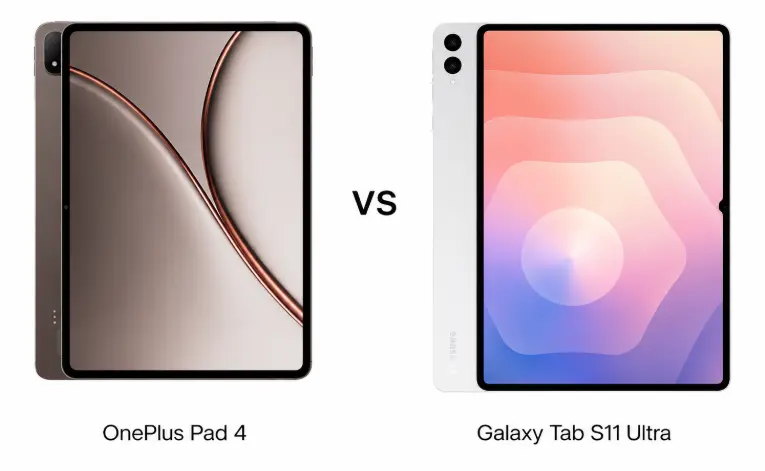
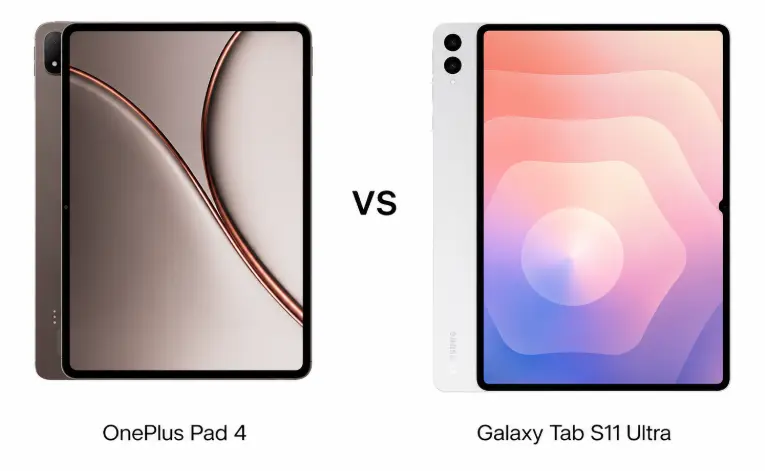
Two heavyweights in the premium Android tablet space, the OnePlus Pad 4 and Samsung Galaxy Tab S11 Ultra, are battling for the attention of discerning users. Each caters to different priorities: OnePlus emphasizes flagship-level performance, a massive battery, and a smooth 144Hz display at a competitive price, while Samsung champions a premium viewing experience, durability, and a productivity-focused ecosystem. Let’s dive into the details to see how they stack up.
- OnePlus Pad 4 features a Snapdragon 8 Elite Gen 5 chipset and a 13,380mAh battery with 80W charging.
- Galaxy Tab S11 Ultra offers a 14.6-inch Dynamic AMOLED 2X display with IP68 rating and DeX support.
- Samsung’s tablet includes dual rear cameras (13MP main + 8MP ultrawide) and a 12MP ultrawide front camera.
- Pricing difference is significant: around $700 for OnePlus Pad 4 vs. $1,200 for Galaxy Tab S11 Ultra.
Design and Display: Size and Style Differences
Both tablets sport premium aluminum frames and backs, but Samsung’s Galaxy Tab S11 Ultra brings extra ruggedness with IP68 dust and water resistance and Enhanced Armor Aluminum construction. It also supports cellular connectivity through Nano-SIM and eSIM, making it versatile for mobile professionals.
The OnePlus Pad 4 is slightly lighter (672g) and slimmer (5.9mm thick) despite packing a huge battery, making it comfortable for extended handheld use.
When it comes to displays, the OnePlus Pad 4 offers a sharp 13.2-inch LCD panel with a blistering 144Hz refresh rate and Dolby Vision support, ensuring smooth animations and bright visuals up to 1000 nits.
Samsung steps it up with a larger 14.6-inch Dynamic AMOLED 2X display featuring HDR10+, deeper blacks, richer colors, and a peak brightness of 1600 nits. Although its refresh rate caps at 120Hz, the AMOLED technology provides a noticeably more premium viewing experience, especially for movies and media consumption.
Performance and Software: Power vs. Productivity
The OnePlus Pad 4 is powered by the Snapdragon 8 Elite Gen 5, one of the most powerful mobile chipsets available, paired with speedy UFS 4.1 storage. This combination, along with the high refresh rate panel, makes everyday navigation and gaming extremely fluid.
Samsung’s Galaxy Tab S11 Ultra uses the flagship Dimensity 9400+ processor, which also delivers excellent performance for multitasking and gaming. For most users, real-world performance differences will be minimal.
Samsung’s One UI 8.5 software brings Wireless DeX, transforming the tablet into a desktop-like environment. The presence of a microSD card slot adds storage flexibility, and Samsung’s wider ecosystem integration remains a strong productivity advantage.
OnePlus’ OxygenOS provides a clean interface with solid multitasking features but lacks a direct DeX competitor. Performance enthusiasts might favor OnePlus for raw speed, while productivity-focused users may lean toward Samsung’s broader feature set.
Battery and Accessories: Endurance vs. Ecosystem
Battery capacity heavily favors the OnePlus Pad 4, which packs a massive 13,380mAh battery—one of the largest in premium tablets—ensuring extended usage for gaming, streaming, and work.
The Galaxy Tab S11 Ultra includes an 11,600mAh battery, respectable but potentially less enduring given the power demands of its AMOLED display.
Charging speed is another gap: OnePlus offers an impressive 80W wired charging that dramatically reduces downtime, whereas Samsung provides 45W charging, which is sufficient but slower.
Both tablets support stylus input, but Samsung’s mature ecosystem includes more accessory options and better integration with other Samsung devices. OnePlus is improving in this area but still trails behind.
Camera and Media: Versatility vs. Volume
While tablet cameras aren’t usually a primary buying factor, Samsung’s Galaxy Tab S11 Ultra provides a more versatile setup with a 13MP main camera plus an 8MP ultrawide lens, useful for document scanning and capturing wider scenes.
OnePlus Pad 4 relies on a single 13MP rear camera, adequate for occasional snaps but less flexible.
For selfies and video calls, Samsung again leads with a 12MP ultrawide front camera, fitting more participants comfortably. OnePlus offers an 8MP front shooter that performs adequately but is less impressive for group conferencing.
Both support 4K video recording, but audio is where OnePlus makes a splash with an eight-speaker system capable of higher volume and immersive sound, while Samsung has four stereo speakers tuned for premium media consumption.
Pricing: Value vs. Premium Experience
The price gulf between these tablets is notable. The OnePlus Pad 4 is priced around $700 (₹60,000), delivering flagship-level performance, a high-refresh display, huge battery, and fast charging at nearly half the cost of Samsung’s offering.
The Galaxy Tab S11 Ultra comes in at about $1,200 (₹111,000), justifying its premium price with AMOLED display tech, DeX functionality, IP68 certification, expandable storage, and cellular connectivity.
Unless Samsung’s unique features are essential to your workflow or preferences, the OnePlus Pad 4 offers significantly better value per dollar.
Via: Gizmochina