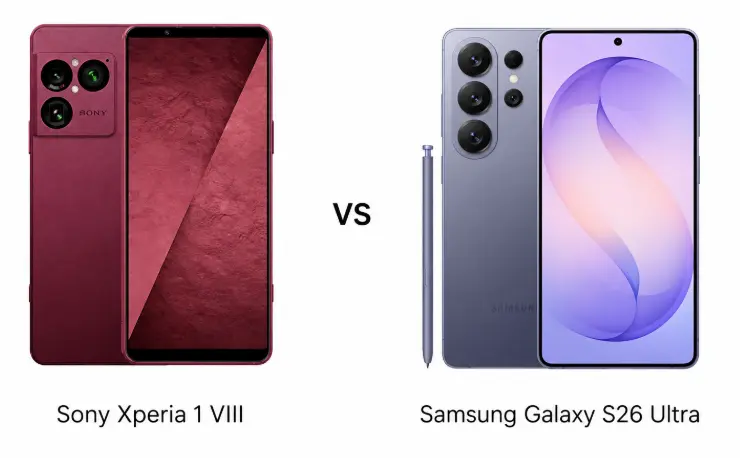
The battle between Sony Xperia 1 VIII and Samsung Galaxy S26 Ultra is more than specs—it’s a clash of philosophies. Sony bets on creator tools and practical features, while Samsung pushes flashy tech and versatility. Why care? Because this split highlights where flagship smartphones are heading and what you might actually need.
- Sony embraces creator-focused hardware: headphone jack, microSD slot, manual camera controls.
- Samsung dominates with a brighter 1440p Dynamic AMOLED display and integrated S Pen.
- Both share Snapdragon 8 Elite Gen 5 chipsets, but Samsung adds faster charging and longer software support.
- Camera approaches diverge: Sony for natural colors and manual control, Samsung for megapixels and AI-driven versatility.
Flagship Power, Mid-range Compromises
Let’s start with design. Sony’s Xperia 1 VIII refuses to chase flashy trends. Flat edges, aluminum frame, dedicated microSD card slot, and a 3.5mm headphone jack—features vanishing from most flagships. This makes it a niche pick for enthusiasts who want flexibility over flash.
Samsung’s Galaxy S26 Ultra goes full futuristic: curved Gorilla Armor 2 glass, integrated S Pen, and an anti-reflective coating that actually improves outdoor visibility. It’s less about practicality and more about luxury and convenience.
Display-wise, Samsung pulls ahead with a Dynamic LTPO AMOLED 2X panel that hits 1440p resolution and much higher peak brightness. Sony’s LTPO OLED is no slouch with 120Hz smoothness and accurate colors, but it feels more subdued and less immersive in daily use.
Three Hours to Full Charge? That’s the Trade-off
Under the hood, both run Snapdragon 8 Elite Gen 5 chips with Adreno 840 GPUs, so raw performance differences are marginal. Samsung’s slightly higher clock speeds and software optimization might edge out benchmarks and sustained gaming sessions.
Battery capacity matches at 5000mAh, but Samsung’s charging is a clear win: 60W wired and 25W wireless versus Sony’s 30W wired only. For people on the move, that convenience matters. Sony tries to offset slower charging with bypass charging to preserve battery health, but don’t expect miracles.
Samsung’s promise of seven years of Android updates also beats Sony’s shorter support window, making it a safer long-term investment.
Manual Control vs AI Overload in Cameras
Sony’s camera system targets creators who want control. The Xperia 1 VIII sports a triple 48MP Zeiss optic setup with advanced eye tracking and manual controls. It’s about natural colors and subtle tuning rather than overprocessed shots.
Samsung, meanwhile, throws everything at the camera: a monstrous 200MP main sensor, dual telephoto lenses including 5x periscope zoom, and AI-driven computational photography. The result is punchier, share-ready images and advanced video features like 8K recording and stabilization.
For selfies, both have 12MP cameras with 4K recording, but Samsung adds HDR10+ and stronger image processing, making it the better choice for social media fans.
Paying for Practicality or Premium Versatility?
The Xperia 1 VIII carries a global price near $1600, while the Galaxy S26 Ultra sits closer to $1300—Samsung undercuts Sony in many markets. Samsung’s broader feature set—fast charging, bigger display, longer software support—makes it the safer and often smarter buy.
Sony’s pitch is clear: if you want expandable storage, a headphone jack, and Alpha camera integration, you’ll pay a premium for those rare features. But for most, Samsung’s package feels more balanced and practical.
The Big Picture
This isn’t just a comparison of two phones—it’s a snapshot of flagship evolution. Sony clings to niche enthusiast features that are vanishing from mainstream devices. That gives it character but limits appeal.
Samsung doesn’t just chase specs; it balances raw power, convenience, and broad appeal. Its longer software support and faster charging alone tip the scales for most buyers.
For creators and audio purists, Xperia 1 VIII remains compelling. For everyone else, Galaxy S26 Ultra offers a more polished, versatile flagship experience. The catch? Sony’s features won’t justify the price for the average user. Samsung’s approach is simply more future-proof and user-friendly.
Disclaimer: This analysis is based on available specs and early reports. Real-world performance and user experience will vary.
(Via)