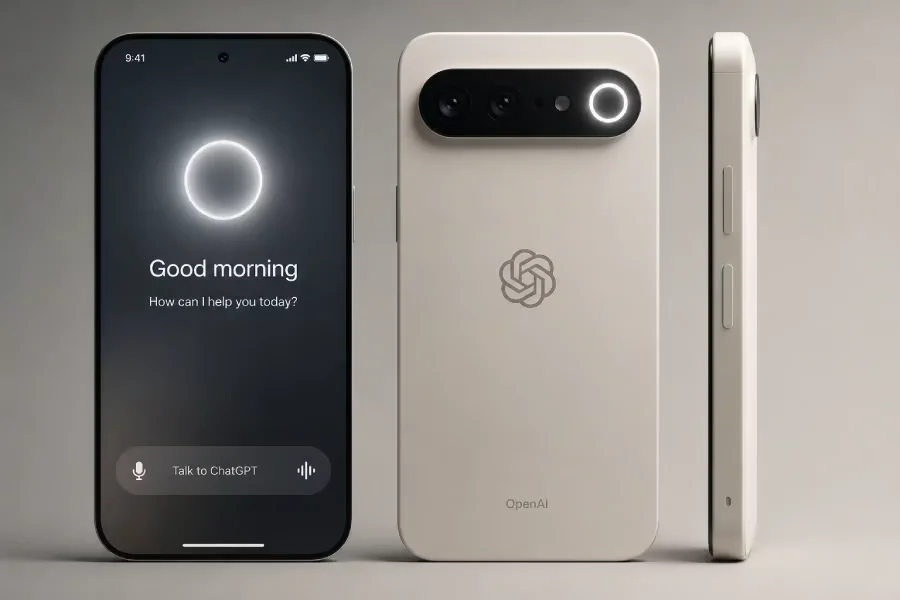
Launching a smartphone centered entirely on AI agents instead of traditional apps is a bold move from OpenAI, aiming to blur the lines between software and hardware. The anticipated release in early 2027 places it in direct competition with flagship models like the iPhone 18 Pro.
OpenAI’s approach focuses on delivering a device optimized for continuous AI tasks, powered by a custom 2nm MediaTek Dimensity 9600 chip. This chip features dual neural processing units (NPUs) tailored for different AI workloads such as vision and language, offering specialized computation that typical processors can’t match.
- Custom 2nm MediaTek Dimensity 9600 SoC with dual NPUs
- LPDDR6 RAM for high memory bandwidth
- UFS 5.0 storage for fast read/write speeds
- Enhanced HDR image processing to improve AI perception
AI-Driven Hardware That Supports Persistent Agentic Computing
The inclusion of LPDDR6 RAM and UFS 5.0 storage highlights the phone’s need for rapid data access and processing. These components are critical because AI agents require constant data flow to perform real-time environment sensing and user interaction. The upgraded HDR pipeline in the image signal processor further enhances the phone’s ability to understand and respond to physical surroundings.
Security and Data Protection with pKVM
OpenAI incorporates a protected Kernel-based Virtual Machine (pKVM) to isolate sensitive AI operations and user data. This approach aims to secure the AI agent’s processes, which is important given the personalized and potentially privacy-sensitive nature of continuous AI assistance.
Market Ambitions and Availability Outlook
OpenAI targets producing 30 million units between 2027 and 2028, intending to capture premium smartphone users who are already familiar with ChatGPT. The company hopes to create a sticky ecosystem by combining hardware with subscription-based AI services. However, the project is still in development, and final specifications or supply chain details could change.
The trade-off is capacity and maturity. While the phone promises advanced AI integration, early adopters may face the usual challenges of a new platform, including app ecosystem development and global availability. Buyers interested in AI-first smartphones should watch for more concrete details as the launch approaches.
Consider the OpenAI phone if you want a device designed from the ground up for AI interaction and are comfortable with emerging technology risks. Skip it if you prefer mature ecosystems with broad app support and proven hardware reliability.
(Via)