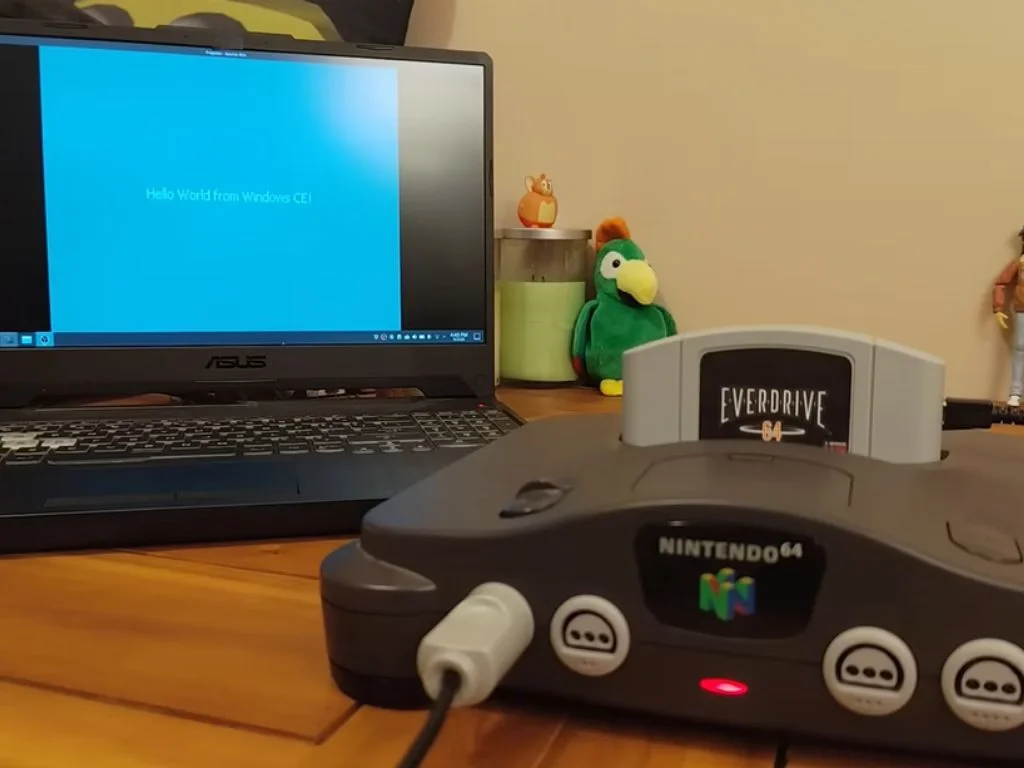
Running modern operating systems on retro consoles is often a curiosity project, but one modder took it a step further by porting Windows CE 2.11 to the Nintendo 64. While the N64 was never designed as a PC, the shared MIPS architecture between the console and older IBM Workpad laptops sparked the idea. The result is a fully functional desktop environment on a gaming console released in the late 1990s.
This project isn’t for practical computing, but it offers a fascinating look at how hardware can be repurposed. Using Microsoft’s old Platform Builder tools, the developer wrote custom drivers to handle the N64’s unique graphics, input, and audio hardware. The EverDrive 64 X7 cartridge plays a crucial role, loading a 3.5 MB ROM that boots Windows CE directly on the console.
- Windows CE 2.11 runs natively on N64 hardware using custom drivers.
- Standard N64 controllers function as a mouse, with support for the official N64 mouse.
- Apps can be loaded from an SD card via the EverDrive cartridge.
- Graphics and audio utilize the console’s built-in hardware for authentic retro performance.
The 140W Claim Depends on How You Use It
Actually, in this case, the bigger question is how far you want to push a gaming console as a general-purpose device. The modded N64 boots into Windows CE in seconds, presenting a familiar interface with a Start menu, taskbar, and desktop icons. The N64 controller’s analog stick and buttons are mapped to mouse movements and clicks, making basic navigation possible. For better precision, the official N64 mouse can be used. Programs designed for Windows CE can be loaded from an SD card, though the console’s limited memory and processing power impose clear limits.
The Real Trade-Off Is Usability vs. Hardware Limits
The trade-off is capacity and performance. The N64’s hardware wasn’t built for multitasking or heavy applications. While this mod demonstrates impressive technical skill, the user experience is understandably slow and constrained. Storage depends on the EverDrive cartridge’s SD card slot, and the display output is limited to the N64’s standard resolutions. Users looking for a functional portable or desktop device will find this more of a novelty than a practical solution.
The Price Makes More Sense for Hobbyists and Collectors
The cost of replicating this setup includes purchasing an EverDrive 64 X7 cartridge, which can be around $150-$200, plus the N64 console itself. Since this is a DIY project without official support, it appeals mainly to enthusiasts who enjoy tinkering with retro hardware. The software is available freely via the developer’s GitHub, but setup requires technical know-how. Availability varies by region, and buyers should consider the investment relative to the limited practical use.
Consider It if You Value a Unique Retro Tech Challenge
This Windows CE port to the Nintendo 64 is a remarkable demonstration of reverse engineering and creative hacking. Consider it if you enjoy exploring the boundaries of vintage hardware and want a unique conversation piece. Skip it if you need a reliable or speedy device for everyday computing. The mod is less about practical use and more about showcasing what’s technically possible with patience and skill.
(Via)