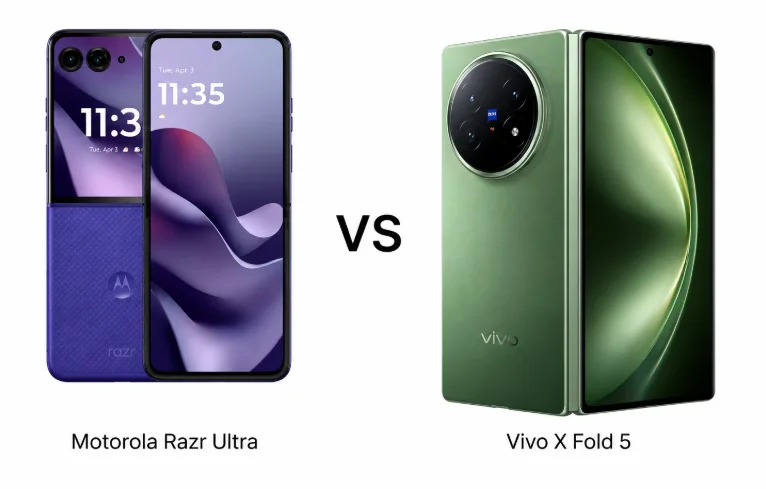
Foldable smartphones are no longer just futuristic curiosities—they’re now contenders to replace traditional flagships. The Motorola Razr Ultra 2026 and Vivo X Fold 5 take starkly different routes: one favors compact style and raw speed; the other bets on productivity, battery muscle, and camera versatility.
- Motorola Razr Ultra 2026 features a compact flip design with Snapdragon 8 Elite and a sharp 165Hz display.
- Vivo X Fold 5 offers a larger 8.03-inch foldable screen, triple cameras with periscope zoom, and a 6000mAh battery.
- Razr Ultra targets portability and flagship-level speed; Vivo focuses on endurance and multitasking.
- Pricing is close, but Motorola leans premium on performance while Vivo sells on hardware value.
Flagship Power, Mid-Range Compromises: Design and Display Face-Off
The Razr Ultra 2026 is built for users who want a phone that’s easy to pocket and feels fresh. Its aluminum frame, Gorilla Glass Ceramic, and IP48 rating give it a premium vibe. The outer display isn’t just a gimmick—it actually works well for quick tasks and notifications. This makes unfolding optional, which is a rare luxury in foldables.
Vivo’s X Fold 5 abandons compactness for a bigger, inward-folding experience. Its 8.03-inch panel leans into multitasking and media consumption, with a businesslike build and stronger water resistance. The cover screen tries to mimic a traditional flagship phone, but it’s the inner tablet-like display that steals the show.
On paper, Motorola’s 165Hz panel promises buttery smoothness and punchy colors while Vivo bets on brightness and PWM dimming for extended comfort. The Razr Ultra is more stylish and fun day-to-day; Vivo’s foldable feels like a productivity tool.
Snapdragon 8 Elite vs Snapdragon 8 Gen 3: Performance and Battery Tug of War
Motorola’s Razr Ultra 2026 uses the newer Snapdragon 8 Elite. The chip delivers noticeably stronger raw performance and better efficiency than Vivo’s Snapdragon 8 Gen 3. This means gaming and multitasking should feel snappier on Motorola’s foldable. The 165Hz refresh rate adds to the fluid experience.
Vivo, meanwhile, prioritizes balanced thermals and a software experience optimized for multitasking on a large display. The Snapdragon 8 Gen 3 isn’t weak, but it’s tuned for endurance and stability rather than peak speed.
Battery-wise, Vivo’s 6000mAh silicon-carbon pack dwarfs Motorola’s 5000mAh cell. Coupled with 80W wired and 40W wireless charging, Vivo aims to keep heavy users running longer with fewer breaks. Motorola’s 68W charging is fast but battery life will likely fall short of Vivo’s endurance, especially with 5G and high brightness.
Camera Wars: Flexibility vs Focused Performance
Vivo’s camera system is the more versatile one. The triple-camera array includes a periscope telephoto lens with 3x optical zoom and Zeiss tuning, geared for users who want flagship-level photography from a foldable. Color science is reportedly more cinematic and balanced in varied lighting.
Motorola keeps it simple with dual 50MP sensors focused on wide and ultrawide shots. Its strength lies in video: advanced 4K and 8K recording with Dolby Vision support. The flip design also enables unique shooting angles and hands-free use. For selfies, Motorola’s 50MP front shooter beats Vivo’s dual 20MP setup in detail and clarity.
In short, Vivo is the all-around photography pack leader, while Motorola offers sharper selfies and stronger video features suited for content creators.
Price Tags Close, But Priorities Diverge
Motorola’s Razr Ultra 2026 is pegged around $1500; Vivo X Fold 5 comes in slightly cheaper near $1200. Regional pricing quirks blur the line, so both fall into the premium foldable bracket.
Motorola justifies its price with cutting-edge chipset, compact foldable engineering, and a premium outer display experience. It’s a luxury piece for enthusiasts who want style and speed.
Vivo sells a broader hardware package—bigger battery, telephoto camera, multitasking display, and faster charging. It’s a more practical foldable for users who need endurance and flexibility.
The Big Picture
Motorola Razr Ultra 2026 and Vivo X Fold 5 represent two distinct philosophies in foldables. Motorola bets on style, speed, and a refined flip experience that stands out in the foldable crowd. Vivo opts for practical versatility, bigger screen real estate, and endurance suited to heavy multitaskers and media consumers.
Based on the spec sheet, Motorola wins on raw performance and compact usability. Vivo offers better battery life, camera versatility, and multitasking software. Real-world usage will expose trade-offs—Motorola’s smaller battery might disappoint heavy users, while Vivo’s larger form factor may not appeal to those seeking pocket-friendly design.
For buyers weighing these options, the choice boils down to what matters more: portability and flagship speed, or productivity and battery muscle. Neither foldable is perfect, but both push the market forward in distinct ways.
Disclaimer: This comparison is based on available specifications and early reports. Actual performance and experience may vary with software updates, real-world usage, and regional variants.
(Via)