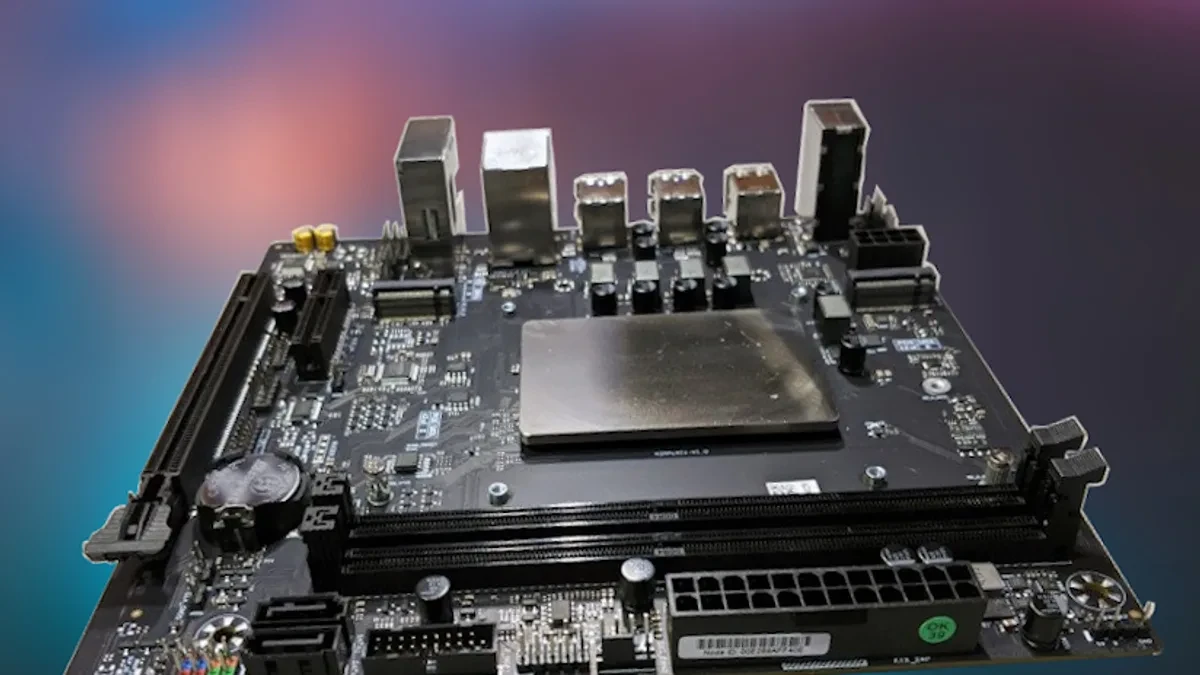
Maxsun has introduced two budget-friendly desktop motherboards powered by Intel mobile processors, giving system builders access to laptop silicon without standard laptop thermal limits. The MS-MoDT 230H D4 Wi-Fi and MS-MoDT 205H D4 Wi-Fi bring mobile-on-desktop configurations to custom PC builds starting at just $150.
By pairing soldered Intel Core 7 230H and Core 5 205H processors with standard desktop DDR4 memory slots and LGA1700 cooler mounting holes, these hybrid motherboards aim to deliver efficient performance for budget desktops, small-form-factor builds, and home server setups. Initial testing from community benchmarkers suggests that freeing these laptop chips from thin laptop chassis yields surprising performance gains.
Higher Power Limits Unlock Extra Mobile Performance
When laptop processors are built into full desktop motherboards, thermal dissipation and power limits change dramatically. Tested by forum user emtec92 on MySKU, the Maxsun boards let these mobile chips run at higher default power targets than typical portable machines. Both motherboards set a baseline power limit of 85W out of the box, with options to push power consumption higher.
During benchmarking, the $210 MS-MoDT 230H D4 Wi-Fi, equipped with a 10-core, 16-thread Core 7 230H processor boosted up to 5.2 GHz, was pushed to 110W. In synthetic workloads like the AIDA64 SHA3 and ZLib tests, the board scored 3,651 and 1,034 points respectively. This comfortably outpaced laptops using similar mobile silicon, such as the Gigabyte A18 Pro and Asus V3607V equipped with the Core 7 240H chip.
Similarly, the $150 MS-MoDT 205H D4 Wi-Fi, featuring an 8-core, 12-thread Core 5 205H processor running up to 4.8 GHz, achieved scores of 2,764 in SHA3 and 779 in ZLib testing. This performance surpassed notebook counterparts like the Lenovo IdeaPad Slim 5 16 and Medion Erazer Scout 17 E1 powered by the Core 5 210H. Because desktop cooling systems can handle sustained 85W to 110W power loads much better than thin laptop chassis, these mobile chips maintain peak clock speeds without immediate throttling.
Desktop Flexibility Meets Budget Constraints
Both motherboards share a compact 190 x 180 mm footprint, fitting into both Mini-ITX and Micro-ATX chassis. To keep costs low, Maxsun opted for standard desktop DDR4-3200 DIMM slots rather than laptop SO-DIMMs or expensive DDR5 memory. Builders can easily reuse existing desktop RAM sticks or purchase inexpensive DDR4 kits.
Expansion capabilities are reasonably solid for the price point. Each board features:
• A primary PCIe 5.0 x8 slot housed within a full-length x16 physical slot for modern graphics cards.
• An additional PCIe 3.0 x4 slot for capture cards or extra controllers.
• Storage options including two M.2 NVMe slots alongside two standard SATA III ports.
• Networking handled via Gigabit Ethernet and a socketed Wi-Fi 6 and Bluetooth 5.3 combo module.
Cooling flexibility is another advantage. Rather than requiring specialized proprietary heatsinks, both boards feature standard LGA1700 mounting holes, allowing users to attach mainstream desktop CPU air or liquid coolers.
Where The Savings Show Their Limits
Despite the strong performance per dollar, these budget boards feature clear design trade-offs. The most noticeable compromise is the total absence of USB-C ports on both models, an unexpected omission for motherboards released in recent years. Users who rely heavily on Type-C peripherals or modern external storage will need to use adapter cables or expansion cards.
Power delivery design also separates the two models. The pricier $210 variant includes passive heatsinks on the power delivery circuitry, whereas the entry-level $150 board leaves the VRM components bare. Users intending to push power limits beyond default settings on the cheaper model may need to ensure strong case airflow to keep power delivery temperatures in check.
Overall, these Mobile-on-Desktop boards offer a practical pathway for users wanting low power idle consumption and compact desktop performance without paying standard desktop CPU prices.