Microsoft has entered the advanced reasoning AI race with its new model, MAI-Thinking-1, developed entirely in-house. The company claims this model surpasses the reasoning capabilities of Claude’s Sonnet 4.6 based on blind human evaluations conducted internally. While this assertion lacks independent verification, it signals Microsoft’s ambition to compete at the top tier of AI reasoning technology.
- MAI-Thinking-1 is Microsoft’s flagship reasoning model, trained from scratch without relying on third-party models.
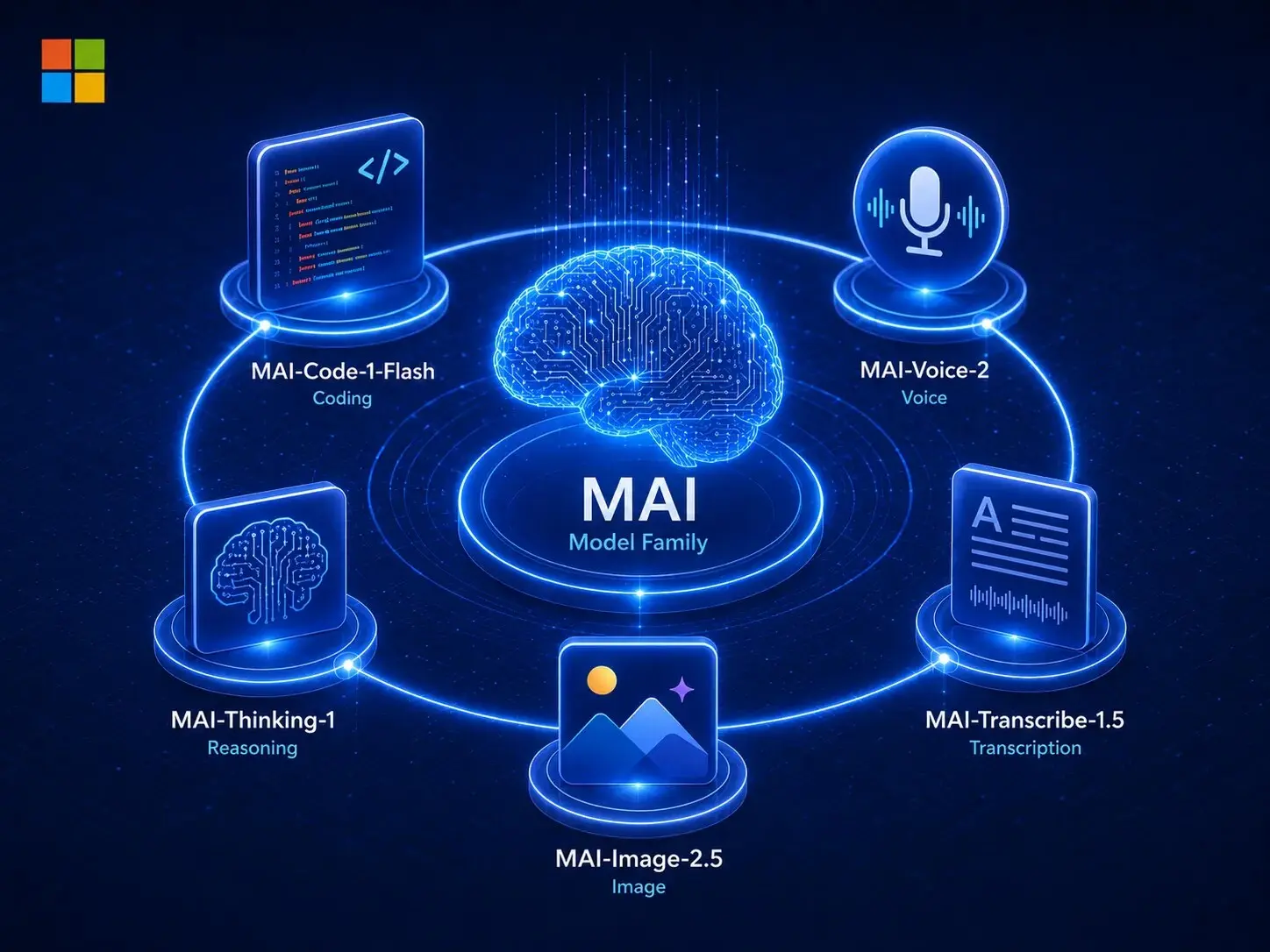
- The MAI family includes seven models covering reasoning, image, voice, transcription, and code tasks.
- Microsoft introduces Frontier Tuning to customize AI models securely with client data and workflows.
- The tuned MAI model for Excel reportedly matches GPT 5.4 performance with up to 10 times greater efficiency.
Building a comprehensive AI ecosystem from scratch
The MAI-Thinking-1 model represents a milestone in Microsoft’s AI strategy, emphasizing full control over data and architecture by training from clean data without external dependencies. This approach contrasts with many AI models that build upon existing frameworks or third-party systems. It targets advanced software engineering and mathematical reasoning, positioning itself as a competitor to leading AI models in these domains.
The broader MAI family consists of six additional models designed to cover a range of AI capabilities. These include MAI-Code-1-Flash, optimized for programming tasks and integrated with tools like GitHub Copilot and Visual Studio Code, boasting 5 billion active parameters and improved efficiency. MAI-Transcribe-1.5 offers fast, multilingual transcription across 43 languages. MAI-Image-2.5 delivers high-quality image generation, reportedly outperforming Nano Banana Pro in Arena scoring. MAI-Voice-2 provides natural audio and voice generation in 15 languages at a more accessible price point.
Frontier tuning: tailoring AI while preserving data control
A key innovation in Microsoft’s announcement is Frontier Tuning, a method to adapt AI models to individual company needs by incorporating proprietary information and workflows within a secure environment. This ensures that business data remains under the customer’s control, addressing common concerns about data privacy and security in AI deployments.
Microsoft highlights that the MAI model tuned specifically for Excel achieves performance on par with GPT 5.4 but with up to 10 times greater efficiency. This suggests significant potential for customized AI solutions that balance power and resource use.
A vision for humanist superintelligence
Microsoft concludes its announcement by framing MAI as part of a broader pursuit of “Humanist Superintelligence,” aiming to develop advanced AI systems that serve people and organizations rather than replace them. This perspective underscores the social and economic implications of AI development, emphasizing collaboration between humans and machines.
While the claims about MAI-Thinking-1’s superiority and efficiency remain to be independently verified, Microsoft’s comprehensive AI ecosystem and focus on customization and data control mark a strategic push into the competitive AI landscape. The coming months will reveal how these models perform in real-world applications and how they influence the balance of power in AI technology.
Via: Notebookcheck