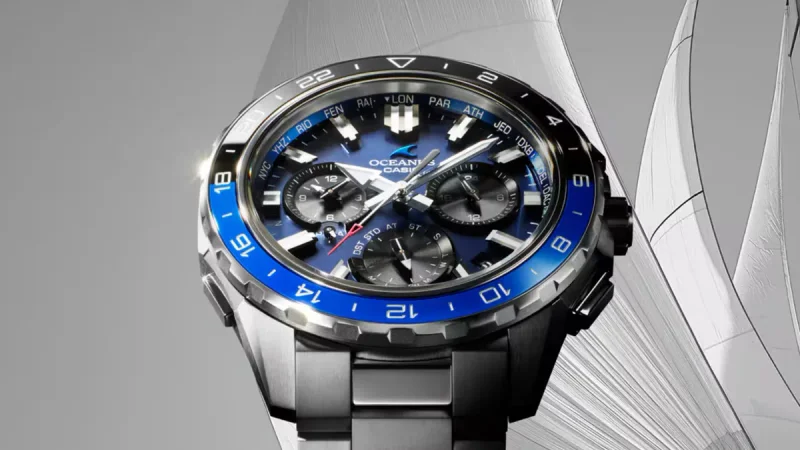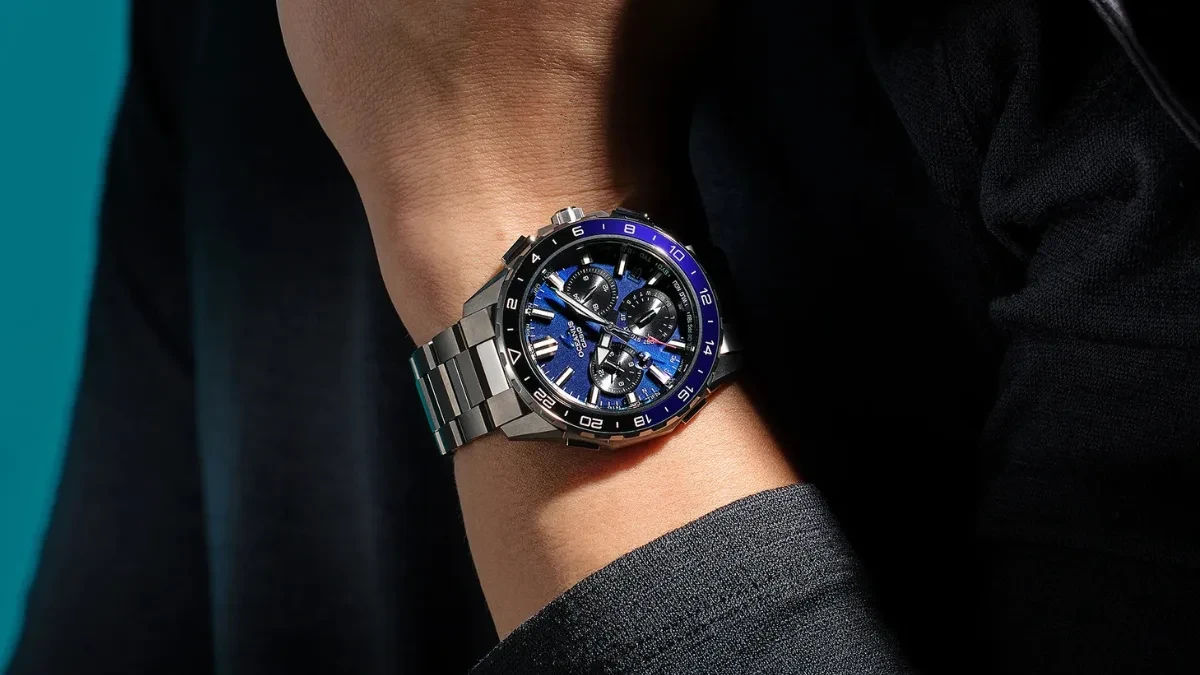
Casio has expanded its premium Oceanus line with three new Cachalot timepieces, introducing a clever mechanical solution for multi-time zone tracking. Scheduled to launch in Japan in October 2026, the OCW-P3000 series replaces messy digital sub-screens and tedious phone menu adjustments with a tactile ceramic bezel mechanism dubbed the Time Zone Navigator.
The new collection includes the OCW-P3000-2A, OCW-P3000-3A, and the dark-finished OCW-P3000B-1A. Designed for global travelers who value classic analog legibility, these watches combine lightweight titanium engineering with advanced physical architecture. While global pricing has not yet been announced, the series provides a fresh benchmark for analog world-time usability.
How the Time Zone Navigator Simplifies World Time
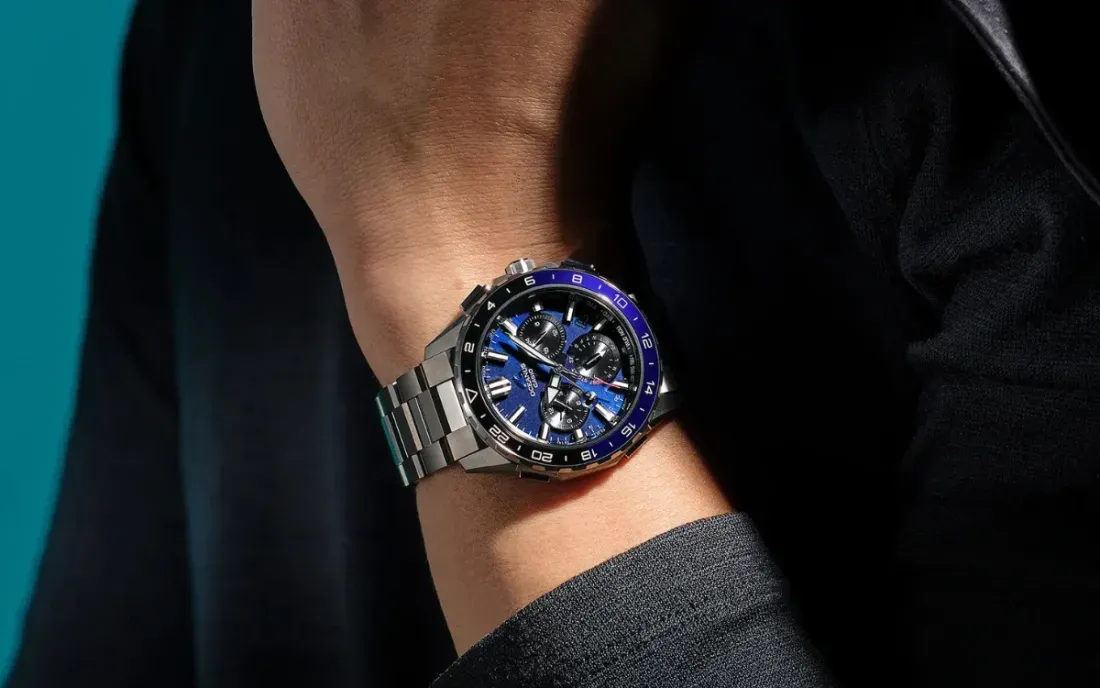
Traditional world-time watches often force users to memorize city codes or cycle through sub-menus to align time zones. Casio bypasses that hassle with a purely physical setup procedure. Pressing a dedicated side button commands the seconds hand to point toward a city on the dial ring where local time is currently midnight.
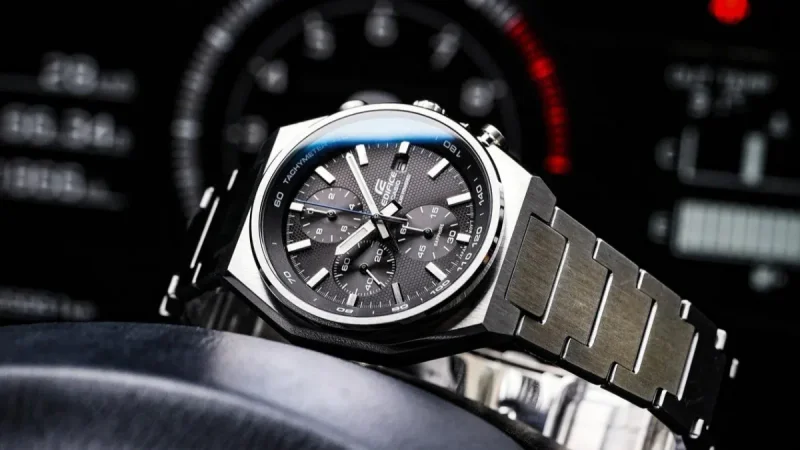
From there, the wearer manually rotates the ceramic bezel until its primary triangle marker lines up with the seconds hand. Once aligned, the 24-hour scale printed across the bezel corresponds directly with 26 city codes surrounding the dial edge. This allows you to check local hours across major global hubs at a single glance. The ceramic bezel insert features a two-tone color split to immediately separate daytime hours from nighttime hours.
Featherweight Titanium and Revised Solar Architecture
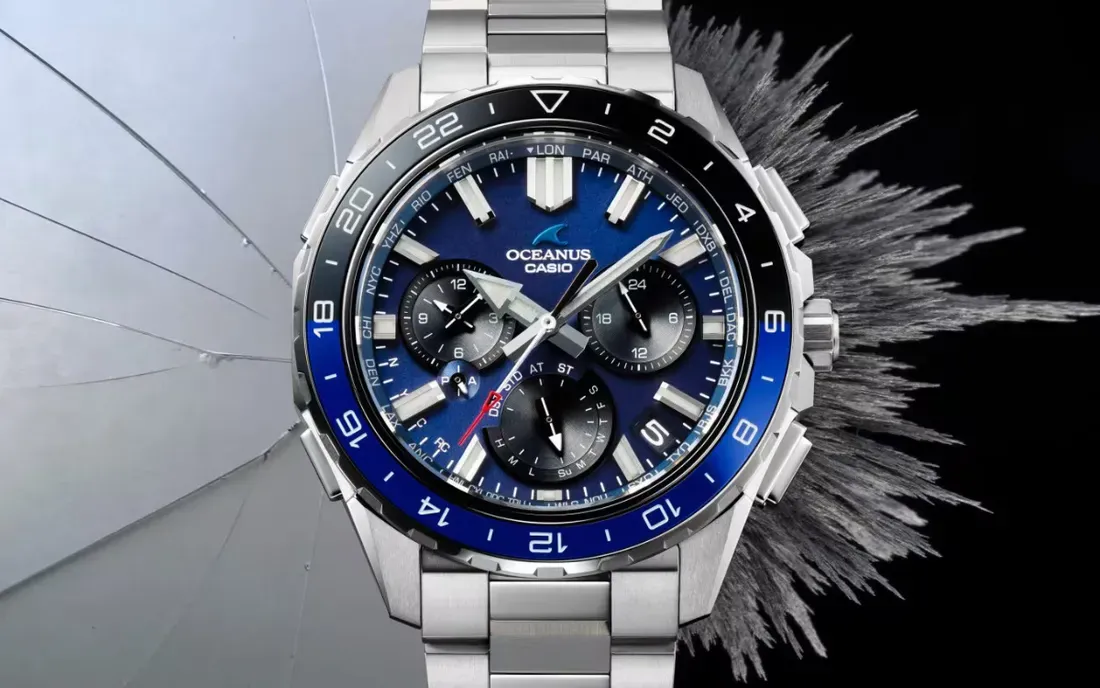
Despite housing complex internal mechanisms and carrying case dimensions of 47.6 x 42.9 x 11.7 mm, the OCW-P3000 weighs just 99 grams. Casio achieved this lightweight profile by crafting both the case and bracelet entirely from titanium. The standard 2A and 3A variants feature a titanium carbide finish, while the premium 1A model receives a Diamond-Like Carbon (DLC) coating for elevated scratch resistance.
Protecting the dial is a dual-curved sapphire crystal finished with anti-reflective coating on both sides. Casio engineers also reworked the internal solar layout. By redistributing the light-harvesting solar cells beneath the perimeter, the sub-dials can now utilize opaque materials. This structural tweak yields significantly sharper color contrast and richer dial textures without reducing solar charging efficiency.
Tough Movement Reliability and Automatic Protections
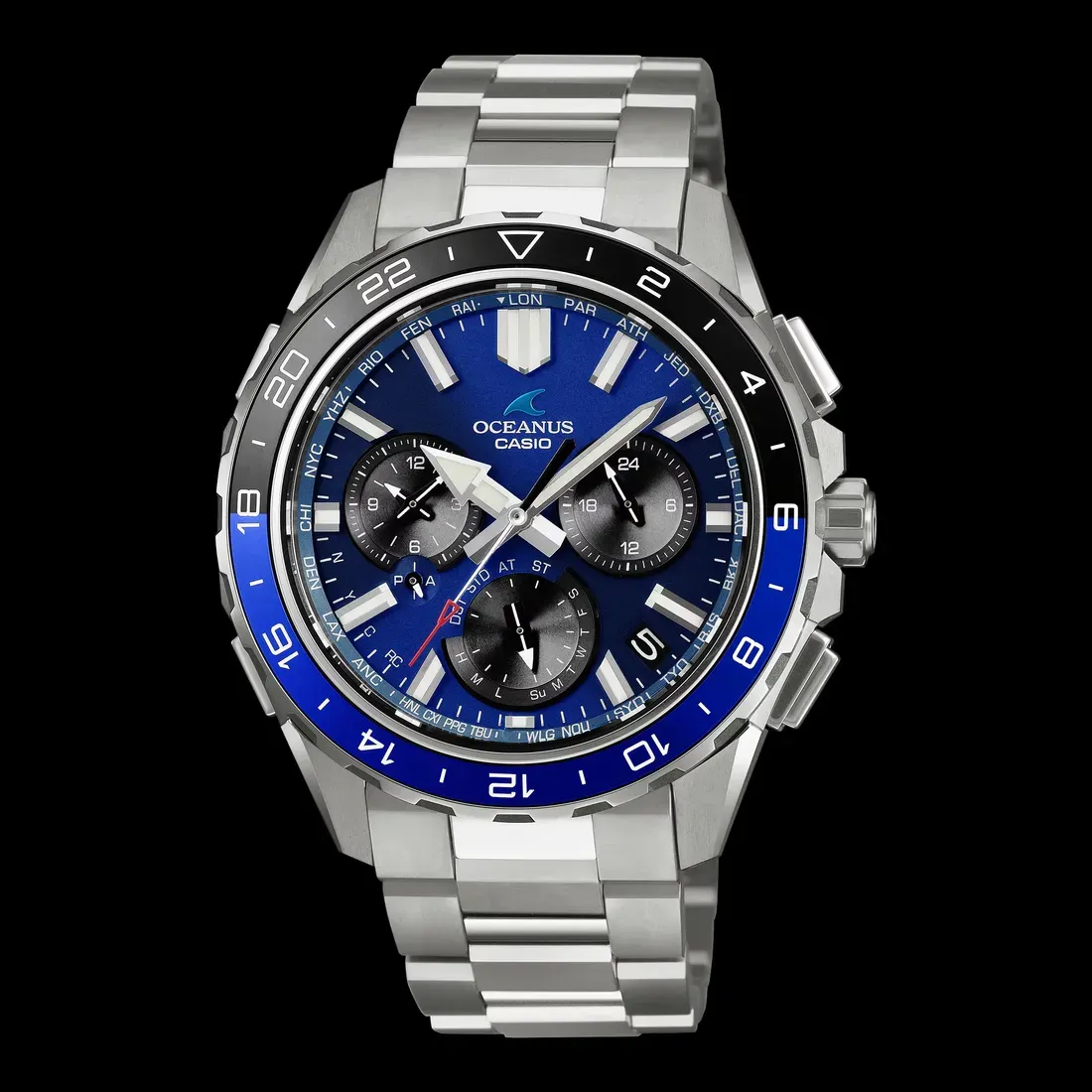
Under the dial, the OCW-P3000 family runs on Casio Tough Movement 2 engine. Primary time synchronization relies on automatic Bluetooth pairing via the Casio Watches smartphone application. When a phone connection is unavailable, the movement defaults to atomic accuracy by receiving Multiband 6 radio signals from six transmission stations worldwide.
Durability remains a core focus of the Cachalot design. An integrated shock detection sensor monitors physical impacts: if a severe jolt knocks the hands out of position, the system automatically recalibrates them to precise alignment. Furthermore, an onboard magnetic field sensor temporarily halts hand motion whenever strong electromagnetic interference is detected, resuming normal operation once the environment stabilizes.
With a full solar charge, the internal battery supports months of operation in complete darkness, delivering continuous accuracy for frequent flyers and watch enthusiasts alike.