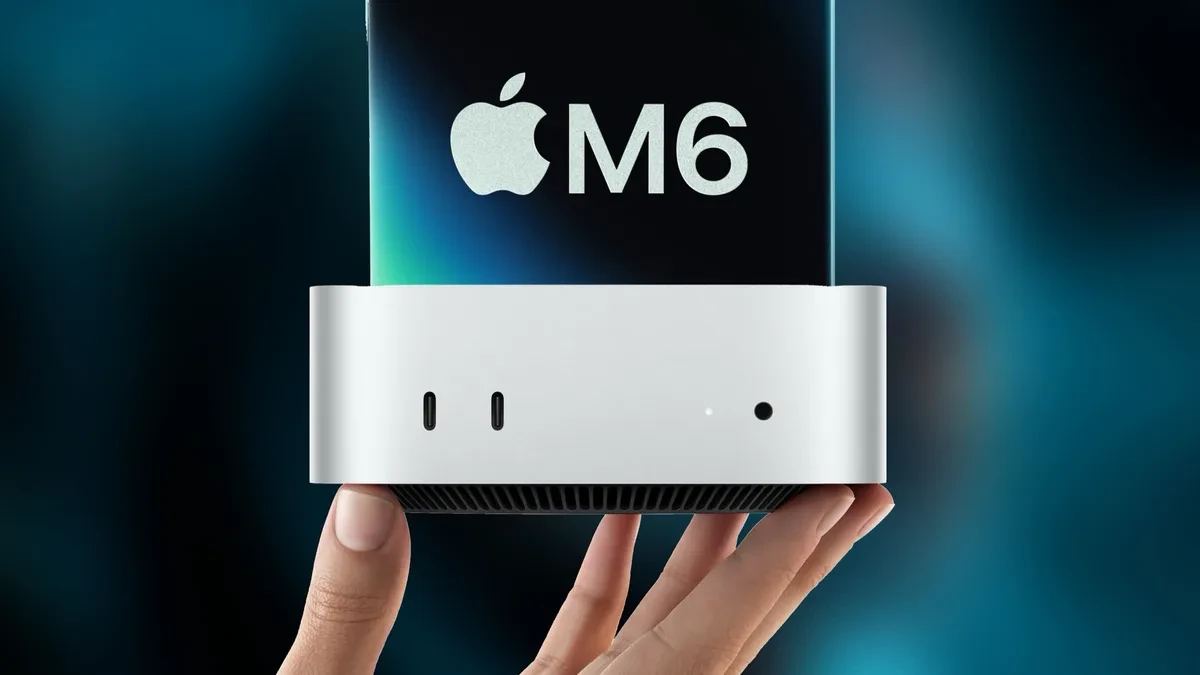
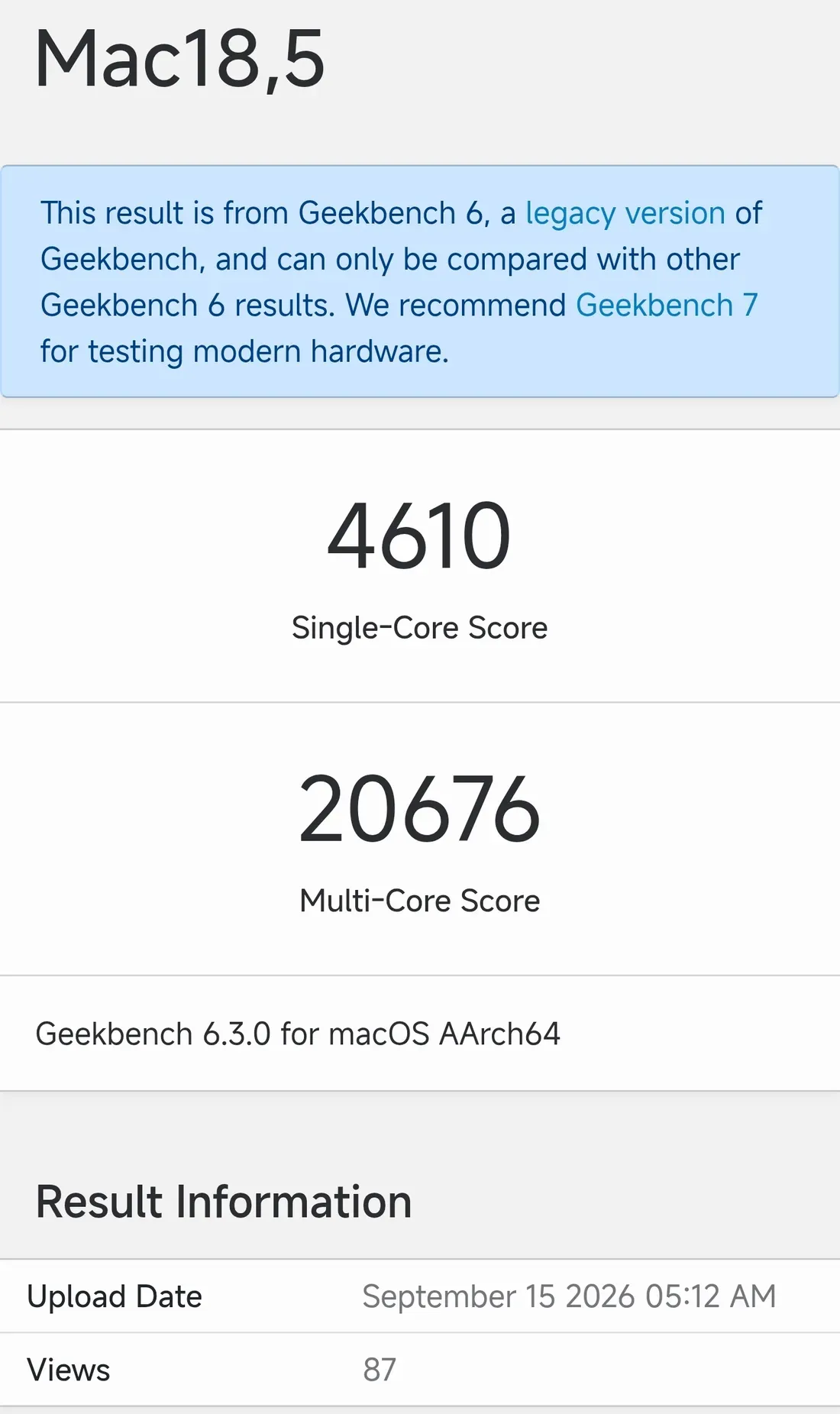
A leaked Geekbench 6.3 benchmark listing for a next-generation Mac mini equipped with Apple's unreleased M6 silicon has surfaced online, revealing major multi-core upgrades alongside an unexpected internal rivalry. The benchmarked machine, designated under the model identifier Mac18,5, recorded a single-core score of 4,610 and a multi-core score of 20,676 while running macOS 27.0 with 32 GB of unified memory. While these numbers mark a substantial generational step forward for desktop Mac mini hardware, they also show the desktop chip trailing the single-core clock speeds of Apple's latest flagship smartphone processor.
In single-core tasks, the M6 benchmark score falls slightly behind the A20 Pro chip found inside the iPhone 18 Pro line, which achieved a single-core result of 4,725 at a peak clock speed of 4.93 GHz. Despite the Mac mini boasting an active cooling fan and a far larger thermal envelope, the iPhone processor squeezes out a roughly 2.5% advantage in single-core speed. This contrast highlights a fascinating shift in how Apple designs its silicon cores across mobile and desktop form factors.
A Solid Generational Step Forward Over the M5
The new benchmark confirms the three-tier CPU architecture Apple detailed during its initial chip architecture announcements. The M6 features a 12-core cluster split made up of two super cores, four performance cores, and six efficiency cores (a 2+4+6 configuration). Paired with 32 GB of memory, which represents the maximum configurable capacity for the baseline M6 tier, the overall architecture represents a refined distribution of workload responsibilities.

When measured against the outgoing 10-core M5 processor, which maintains median scores of 4,195 in single-core and 17,072 in multi-core across standard benchmark runs, the M6 delivers roughly a 10% increase in single-core performance and a 21% jump in multi-threaded workflows. This multi-core boost aligns closely with official performance targets, confirming that heavy multi-threaded workloads like 8K video rendering, code compilation, and local AI model execution will see tangible productivity gains.
Why the iPhone Chip Clocks Higher Than Desktop Silicon
The most intriguing aspect of the benchmark is the single-core gap between the M6 and the A20 Pro. The A20 Pro operates at a peak clock speed of 4.93 GHz, approximately 3% higher than the maximum clock rate observed on the M6 sample. In desktop systems with active cooling fans, higher clock speeds are typically easier to maintain, making the mobile processor's single-core lead surprising at first glance.
An architectural explanation posted on Baidu Tieba sheds light on why Apple may have opted for this distinction. According to the breakdown, the M6's super cores retain the 10-wide instruction decode architecture used in previous desktop designs, prioritizing high instruction throughput per clock cycle. Conversely, the A20 Pro adopts a redesigned super core with a narrower 9-wide decode engine. By trimming the decode width slightly, Apple reduced decoder timing constraints and thermal density, allowing the mobile core to push higher sustained clock frequencies within the tight thermal confines of a fanless smartphone chassis.
Architectural Divergence and Production Expectations
This divergence suggests Apple is tailoring its core architectures specifically for device form factors rather than applying a single uniform core design across all product lines. While mobile devices rely on ultra-high clock spikes for quick app launches and UI responsiveness, desktop chips benefit from wider instruction execution streams that excel in extended multi-threaded computing tasks. The A20 Pro's lower core count keeps its multi-core score at 12,575, leaving the M6 with an overwhelming 64% lead in total multi-threaded capability.
As with any pre-release Geekbench benchmark, these figures represent early engineering samples rather than final retail hardware. Apple may fine-tune clock frequencies, power limits, and background governor behaviors prior to official retail shipments. However, the initial data proves that Apple's silicon engineering teams are actively reshaping core design balances to maximize performance per watt across both handheld and desktop form factors.