SpaceX is gearing up for the 14th test flight of its massive Starship launch vehicle, targeting a launch window on September 22, 2026. Beyond demonstrating stable orbital capabilities, this milestone flight carries immediate commercial utility: deploying the first operational batch of 26 next-generation Starlink V3 satellites directly into low Earth orbit to strengthen the company's broadband infrastructure.
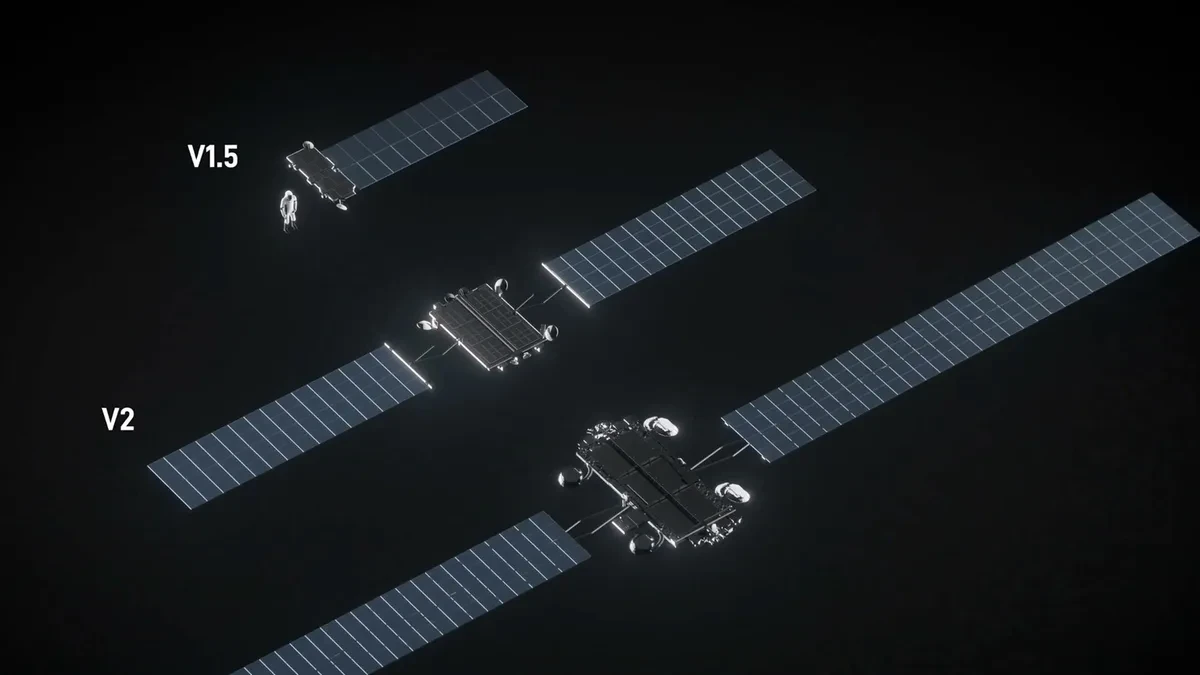
These updated satellites represent a substantial hardware leap, designed to deliver over 100 times the total bandwidth capacity of the current Starlink V2 units launched by Falcon 9 rockets. By taking advantage of Starship's massive payload bay to deploy larger and heavier hardware, SpaceX aims to eliminate bottlenecking in high-density urban areas while maintaining low-latency connectivity in remote regions worldwide.
Engineering the Petabit Laser Mesh Network
The dramatic increase in network throughput stems from structural and architectural redesigns built directly into the V3 platform. Each satellite integrates upgraded phased array antennas capable of handling significantly higher data throughput per square meter. To manage this influx of communications, SpaceX has embedded high-capacity space lasers that allow satellites to communicate directly with one another across orbit.

This interconnected laser system forms a petabit-scale mesh network in space. Rather than relying heavily on ground station relays, the satellites can dynamically route internet traffic through orbital laser links to the nearest available ground terminal. Furthermore, software-driven dynamic beam allocation allows the V3 satellites to shift data density on the fly, concentrating capacity over congested cities during peak hours while seamlessly transitioning power to rural zones when local demand spikes.
Why Starship Is Essential for Next-Gen Hardware
For years, Starlink hardware was constrained by the payload fairing dimensions and mass limits of the Falcon 9 launch vehicle. While Falcon 9 has reliably placed thousands of V1.5 and V2-Mini satellites into orbit, it lacks the volume required to lift the full-scale V3 satellite design. Starship solves this physical limitation entirely with its 9-meter-diameter payload bay.
Because Starship can carry vastly heavier payloads into orbit, SpaceX engineers were able to outfit the V3 satellites with beefier power systems, larger surface-area solar arrays, and high-performance transceivers. Flight 14 marks the transition of Starship from a purely experimental atmospheric prototype into a functional heavy-lift vehicle actively contributing to SpaceX's commercial satellite network.
Flight Profile and Test Objectives
The upcoming mission will originate from the Starbase facility in Boca Chica, South Texas, within a 75-minute window starting at 7:15 a.m. Central Time, pending final clearance from regulatory authorities. Unlike recent test flights where SpaceX attempted high-stakes tower catches of the Super Heavy booster, Flight 14 will forgo recovery maneuvers to focus strictly on flight reliability.
SpaceX has introduced targeted hardware and software revisions to address engine restart issues encountered in earlier flights. Key objectives for Flight 14 include a clean stage separation, executing a precise orbital insertion burn, proving the mechanical deployment sequence of the 26 Starlink V3 satellites, and carrying out a controlled ocean splashdown for both stages. Global consumer pricing and service tier updates leveraging the Starlink V3 constellation have not yet been announced.