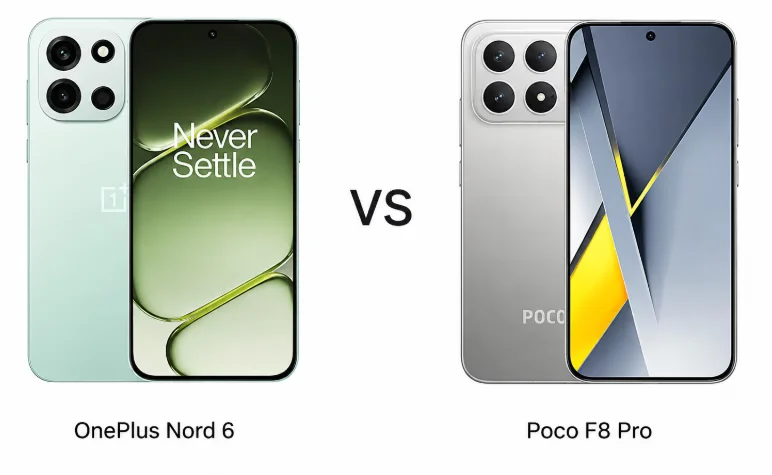
OnePlus Nord 6 and Poco F8 Pro take completely different shots at what a “flagship killer” should be. Nord 6 bets on absurd battery capacity and blistering 165Hz AMOLED smoothness, while Poco F8 Pro zeroes in on flagship-tier performance, camera versatility, and premium materials. Both pack Snapdragon firepower, but which one actually delivers more bang for your buck? Our analysis suggests the answer isn’t straightforward.
Battle of the Builds: Rugged Gaming vs Premium Polish
OnePlus Nord 6 goes heavy on durability: IP68/IP69K ratings and MIL-STD-810H certification make it a tough companion for long sessions, especially gaming marathons. The plastic frame and back might not scream luxury, but they keep the phone lightweight and comfortable. Poco F8 Pro, in contrast, aims for flagship finesse with an aluminum frame, glass back, and Gorilla Glass 7i. The difference is palpable—Poco feels like a premium device you’d want to show off, while Nord 6 is more about function than flash.
Display-wise, OnePlus pushes the envelope with a 165Hz AMOLED and sky-high brightness levels. The result: buttery-smooth animations and lightning-fast touch response that gamers crave. Poco’s screen settles for 120Hz but brings Dolby Vision and richer colors to the table, delivering a more cinematic experience for streaming and general use. On paper, Nord 6’s display sounds superior for gaming, but Poco’s panel feels more refined overall.
Power Play: Massive Battery vs Raw Performance
Poco F8 Pro flexes the Snapdragon 8 Elite and Adreno 830 GPU—a combo that puts it close to ultra-premium Android flagships. Heavy multitasking and AI tasks should be effortless here. The Nord 6 runs Snapdragon 8s Gen 4, which is no slouch but seems tuned for efficiency and thermal stability rather than chasing peak benchmarks.
The catch is simple: Nord 6 packs a monstrous 9000mAh battery on its India variant, easily stretching to two days for moderate users—a rarity in performance phones. Charging is slower at 80W versus Poco’s 100W, but endurance favors Nord 6. Poco charges faster and can handle all-day use, but its smaller battery means power users might feel the burn sooner.
Camera Wars: Versatility vs Simplicity
Poco F8 Pro’s camera setup offers a clear edge—a 50MP telephoto lens for cleaner portraits and better zoom, plus a larger main sensor that shines in low light and video (8K recording included). Slow-motion and video capabilities also lean in Poco’s favor.
The Nord 6 keeps it simple with a dual-camera setup focused on reliability. Daylight shots are sharp and consistent, but it lacks Poco’s flexibility. Though, Nord 6 snags a win on the selfie front with a 32MP front cam capable of 4K video and autofocus. Poco’s 20MP front shooter feels underwhelming given the price gap.
Price Points Tell the Story
Nord 6 undercuts Poco F8 Pro by a significant margin: ₹39,000 vs ₹52,000. OnePlus targets gamers and power users hungry for endurance and high refresh rates without bleeding cash. Poco demands a premium but delivers a more polished flagship experience across build, cameras, and raw power.
The verdict: Nord 6 offers better value for gamers and heavy users focused on battery life. Poco justifies its price for those chasing flagship refinement and better cameras. Neither phone is a clear winner across the board—it boils down to priorities.
GizmoIndo’s Take
What this showdown reveals is a divergence in what “flagship killer” even means in 2024. OnePlus Nord 6 bets on endurance and gaming smoothness, filling a niche starving for battery life without the flagship price tag. Poco F8 Pro, meanwhile, chases the flagship dream with top-tier performance, premium materials, and camera versatility—but at a cost.
Neither phone will satisfy everyone. If you want a phone that lasts forever on a charge and keeps up with gaming demands, Nord 6 is the smarter buy. But if you want a more balanced, polished device with better cameras and don’t mind spending extra, Poco F8 Pro feels like a true flagship in disguise.
Both devices highlight how flagship killers have evolved: the market now splits between ultra-efficient endurance monsters and premium experience flagships. Your call is simple—what matters more: raw power and polish, or battery life and smooth gameplay?
(Via)