For over a decade, astronomers kept a close watch on a cosmic heavyweight 29 million light-years away, bracing for a stellar explosion. The object, cataloged as AT 2016blu, is a luminous blue variable star boasting a mass at least 33 times that of our Sun. Between 2012 and 2026, it triggered 27 violent outbursts that mirrored the sudden, brilliant brightenings typical of a dying star on the verge of a full supernova detonation.
However, fresh multi-wavelength data captured by NASA's Chandra X-ray Observatory has upended that initial demise scenario. Rather than a solitary star undergoing self-destructive terminal spasms, researchers have gathered evidence that AT 2016blu is caught in a high-stakes gravitational dance with a unseen compact companion. This orbital partnership creates periodic celestial fireworks that disguised a routine gravitational feeding process as a series of terminal explosions.
Decoding a Cosmic False Alarm
Luminous blue variable stars are notoriously unstable stellar giants. They undergo giant eruptions as radiation pressure inside the star fights against gravity, shedding huge amounts of mass into surrounding space. Because these stars sit near the theoretical limit of stellar mass, astrophysicists naturally suspected that AT 2016blu was undergoing its final pre-supernova convulsions, shedding its outer envelopes before a core collapse.

What puzzled researchers was the surprising rhythm of these violent optical outbursts. Over 14 years of observation, the outbursts occurred in quasiperiodic cycles lasting roughly 113 days. A single star undergoing chaotic terminal instability rarely displays such strict periodic behavior. The timing suggested an external driver, pointing toward a binary system where a second celestial body routinely interferes with the primary star's atmosphere.
The X-Ray Signature of a Hidden Stellar Vampire
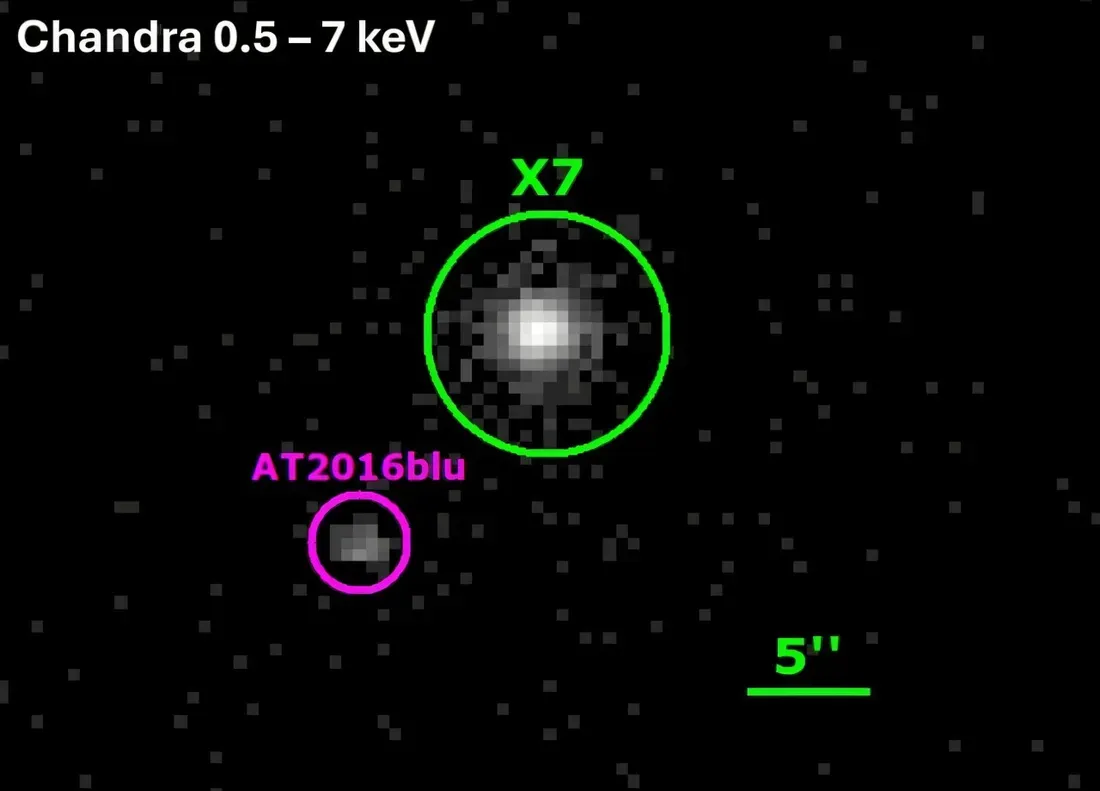
The definitive proof came when astronomers analyzed high-energy X-ray emissions from the region around AT 2016blu. In space astrophysics, intense X-rays often serve as a smoking gun for gravitational accretion. When matter from a huge, puffed-up star gets pulled toward a dense companion, the gas accelerates to extreme velocities, creating friction and superheating to millions of degrees before emitting bright X-ray radiation.
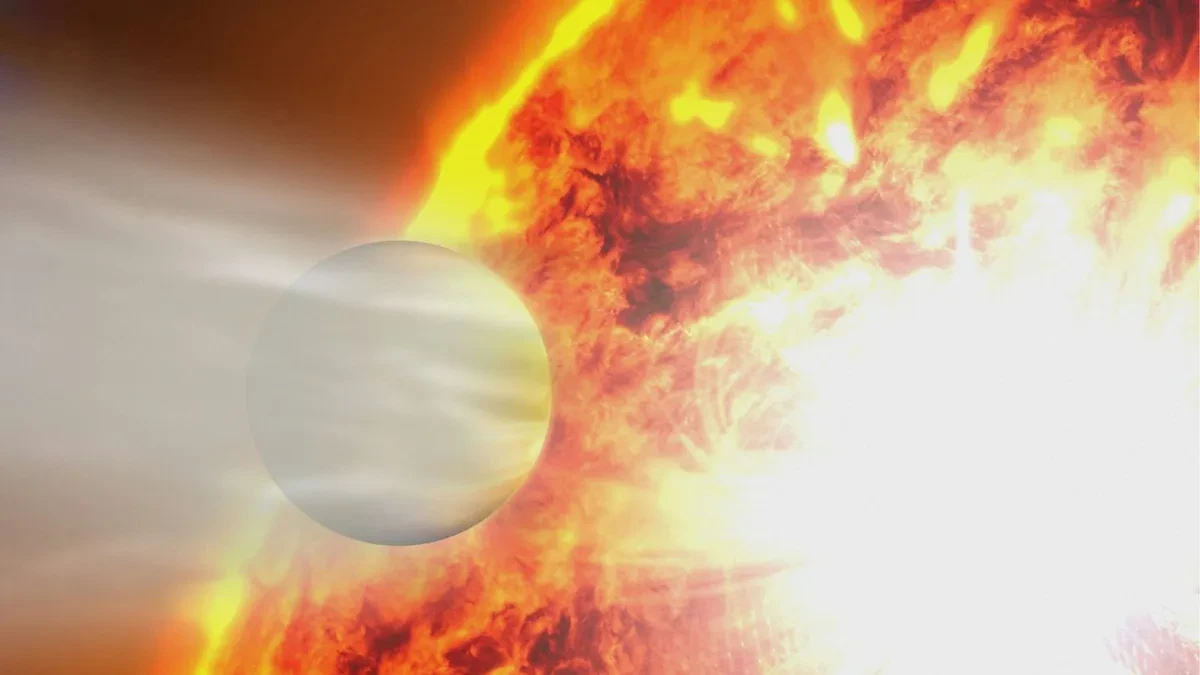
Data compiled from the Chandra X-ray Observatory confirmed that each major outburst coincides with periastron passage, the point in an eccentric orbit where the two celestial bodies swing closest to each other. During this tight approach every 113 days, the ultra-dense companion plunges through the outer gas atmosphere of the giant host star, stripping away huge plumes of material and releasing energetic flares that optical telescopes previously mistaken for supernova imposter events.

Unmasking the Compact Companion
While astronomers now understand the physical mechanism driving these 27 quasiperiodic outbursts, the exact identity of the smaller companion remains an open question. Based on the calculated energetics and gravitational pulls required to strip gas from a 33-solar-mass primary, the unseen object must be a compact stellar remnant. The primary candidates are either a heavy neutron star or a stellar-mass black hole.
If the companion is a black hole, AT 2016blu represents a rare laboratory for observing active high-mass X-ray binary evolution in real time outside our local galactic neighborhood. Continued multi-wavelength monitoring across optical, radio, and high-energy spectra will help refine the orbital parameters and determine the companion's exact mass. Instead of witnessing the immediate death of a supergiant star, astronomers have gained front-row seats to a complex, long-term galactic interaction that reshapes our understanding of how massive binary systems interact before their final evolutionary stages.