

What if a star was actually powered by a black hole? The James Webb Space Telescope (JWST) has revealed an extraordinary object, MoM-BH*-1, that challenges conventional astrophysical categories by combining a massive black hole with a vast gaseous envelope resembling a star. This discovery, dating back to just a few hundred million years after the Big Bang, redefines our understanding of early cosmic structures.
MoM-BH*-1 appears as a bright red dot, roughly the size of the Solar System, yet its energy output exceeds that of any typical star by a factor of 100 billion. Such immense luminosity cannot be sustained by standard nuclear fusion processes. Instead, researchers propose a central black hole, estimated to be 100,000 times the mass of the Sun, enveloped by a dense cloud of hydrogen gas that gives the object its star-like facade.
Unveiling the Black Hole Star's Unique Characteristics
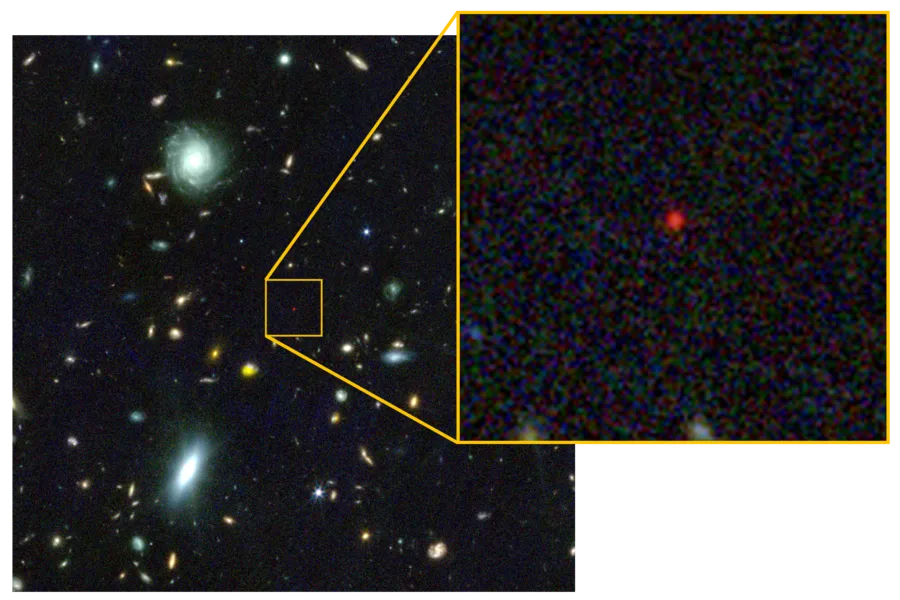
The discovery emerged from the Mirage or Miracle (MoM) survey, which scrutinized JWST data for early galaxies. The object’s intense red hue and spectral properties stood out. Notably, MoM-BH*-1 exhibited a pronounced Balmer break, indicative of dense hydrogen gas absorption, and lacked heavier elements beyond hydrogen and helium. These features defied typical explanations involving dust or conventional stellar atmospheres.
Through detailed simulations, researchers tested various configurations to replicate the observed spectrum and brightness. They concluded that only a model incorporating an actively accreting black hole surrounded by an extensive hydrogen envelope could match the observations. This model portrays a fundamentally new class of astrophysical object distinct from both ordinary stars and black holes.
Usage Context: Understanding the Black Hole Star's Role in Early Universe
The black hole star concept bridges a gap in explaining early universe phenomena, particularly the prevalence of numerous "little red dots" in JWST images. These dots, which have mostly vanished in the modern cosmos, may represent similar black hole stars embedded within nascent galaxies. MoM-BH*-1’s exceptional brightness allows astronomers to observe it in near isolation, shedding light on these enigmatic objects.
Competitor Analysis: Comparing with Known Early Universe Objects
Unlike traditional early stars or quasars, MoM-BH*-1 is powered not by fusion or typical accretion disks alone but by a unique combination of a massive black hole and an extended hydrogen envelope. While quasars are powered by supermassive black holes with accretion disks, the star-like gaseous envelope here is unprecedented, suggesting a new category that complements our understanding of cosmic dawn phenomena.
Key Specifications Highlight
- Central Black Hole Mass: Approximately 100,000 solar masses
- Envelope Size: Comparable to the Solar System's scale
- Energy Output: 100 billion times that of a typical star
- Gas Composition: Predominantly hydrogen and helium, minimal heavier elements
- Spectral Feature: Deep Balmer break indicating dense gas absorption
Source: NASA | NotebookCheck


