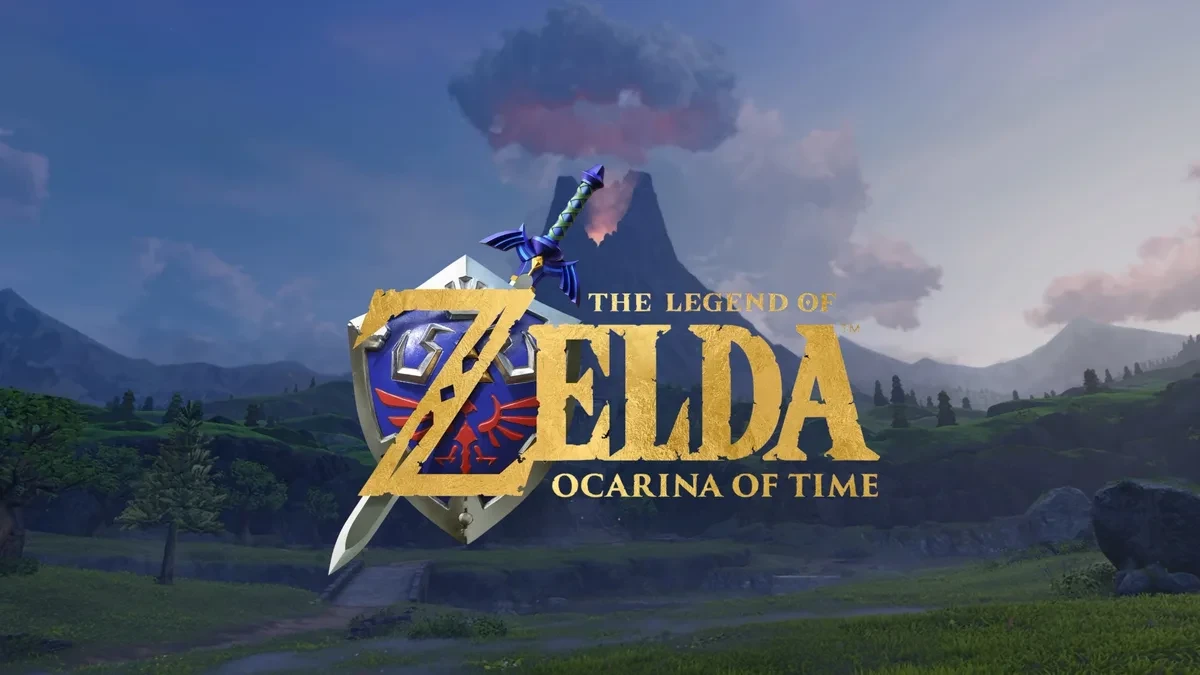
Nintendo's upcoming remake of The Legend of Zelda: Ocarina of Time for the Switch 2 promises a fluid 60 frames-per-second gameplay target at native 1080p resolution, according to a preliminary technical analysis from Digital Foundry. While doubling the frame rate over previous flagship entries like Breath of the Wild and Tears of the Kingdom represents a massive step forward for responsive movement in Hyrule, the title apparently skips Nvidia's Deep Learning Super Sampling (DLSS) in favor of standard native rendering.
In a teardown of early trailer footage, Digital Foundry's Oliver Mackenzie and John Linneman pointed out that while the hardware maintains a steady frame rate, the absence of AI-assisted upscaling leaves noticeable visual blemishes across environments and character models. Without DLSS to handle edge reconstruction and anti-aliasing, early builds exhibit aggressive oversharpening, foliage shimmering, and harsh specular highlighting on character models during close-up dialogue scenes.
Native 1080p Rendering and the 60 FPS Milestone
Achieving a locked 60 fps presentation marks a significant evolution for 3D Zelda titles on portable hardware. Both major open-world Zelda releases on the original Nintendo Switch were capped at 30 fps, frequently experiencing frame drops in heavy weather effects or complex physics scenarios. Digital Foundry's breakdown indicates that during gameplay, the Switch 2 runs the Ocarina of Time remake at a fixed 1080p resolution, with static menu overlays rendering at a higher 1440p canvas.
Rather than relying on temporal upscaling to stretch a lower internal resolution to 4K, Nintendo appears focused on rock-solid frame delivery. This conservative approach to display output suggests that developers prioritize raw motion smoothness and input responsiveness over push-button ultra-high-definition marketing metrics, which aligns with Nintendo's traditional performance priorities.
Proprietary Engine Architecture vs. Unreal Engine 5
Early viewer speculation suggested Nintendo might have adopted Epic Games' Unreal Engine 5 for the remake, given lighting cues seen in initial teaser material. However, Digital Foundry attributes the graphics pipeline to a proprietary in-house solution or a custom engine provided by a long-time development partner. Monolith Soft, which previously provided core technical assistance on Tears of the Kingdom and the Xenoblade Chronicles series, is considered the most likely contributor.
Avoiding third-party middleware like Unreal Engine 5 may explain how the development team achieved 60 fps stability without severe traversal stutter. Epic's engine is notoriously difficult to optimize for mobile and hybrid chipsets, often suffering from shader compilation hitches. A custom-built engine tailored specifically for the Switch 2 custom Nvidia architecture grants tighter control over memory allocation and GPU bandwidth.

The Cost of Skipping Nvidia DLSS
Despite the high frame rate, Digital Foundry heavily criticized the decision to forgo Nvidia DLSS upscaling. Nvidia's AI reconstruction hardware built into the Switch 2 silicon is capable of turning lower render targets into crisp 1440p or 4K signals while resolving fine detail far better than traditional anti-aliasing techniques.
Without DLSS, the 1080p image output relies on basic post-processing sharpeners. This creates noticeable visual artifacts across Hyrule's expansive landscape. Fine vegetation and foliage suffer from temporal shimmering when the camera pans, and character models display an unnatural glossy shine under direct light sources. While the technical preview confirms impressive hardware optimization, refining the image-reconstruction pass before the anticipated November 5 release date could turn a visually uneven presentation into a pristine showcase for Nintendo's new console.